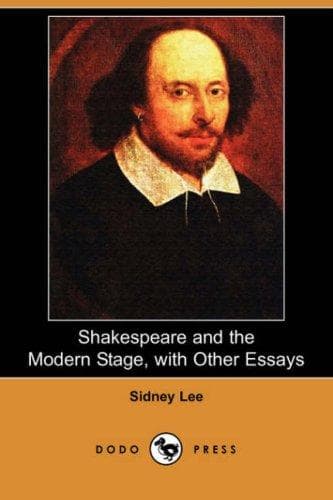
Shakespeare and the Modern Stage; with Other EssaysLee, Sidney, Sir
History
Shakespeare and the Modern Stage; with Other Essays
Lee, Sidney, Sir
Shakespeare, William, 1564-1616; Shakespeare, William, 1564-1616 -- Stage history
A very eminent representative of the culture and political
intelligence of the next generation was in full sympathy with the
verdict of the Eton College tribunal. Lord Clarendon held Shakespeare
to be one of the "most illustrious of our nation." Among the many
heroes of his admiration, Shakespeare was of the elect few who were
"most agreeable to his lordship's general humour." Lord Clarendon was
at the pains of securing a portrait of Shakespeare to hang in his
house in St James's. Similarly, the proudest and probably the richest
nobleman in political circles at the end of the seventeenth century,
the Duke of Somerset, was often heard to speak of his "pleasure in
that Greatness of Thought, those natural Images, those Passions finely
touch'd, and that beautiful Expression which is everywhere to be met
with in Shakespear."
VIII
It was to this Duke of Somerset that Rowe appropriately dedicated the
first full and formal biography of the poet. That work was designed as
a preface to the first critical edition of Shakespeare's plays, which
Rowe published in 1709. "Though the works of Mr Shakespear may seem to
many not to want a comment," Rowe wrote modestly enough, "yet I fancy
some little account of the man himself may not be thought improper to
go along with them." Rowe did his work quite as well as the
rudimentary state of the biographic art of his day allowed. He was
under the complacent impression that his supply of information
satisfied all reasonable curiosity. He had placed himself in the hands
of Betterton, an investigator at first hand. But the fact remains that
Rowe made no sustained nor scholarly effort to collect exhaustively
even the oral tradition; still less did he consult with thoroughness
official records or references to Shakespeare's literary achievements
in the books of his contemporaries. Such labour as that was to be
undertaken later, when the practice of biography had assimilated more
scientific method. Rowe preferred the straw of vague rhapsody to the
brick of solid fact.
Nevertheless Rowe's memoir laid the foundations on which his
successors built. It set ringing the bell which called together that
mass of information drawn from every source--manuscript archives,
printed books, oral tradition--which now far exceeds what is
accessible in the case of any poet contemporary with Shakespeare. Some
links in the chain of Shakespeare's career are still missing, and we
must wait for the future to disclose them. But, though the clues at
present are in some places faint, the trail never altogether eludes
the patient investigator. The ascertained facts are already numerous
enough to define beyond risk of intelligent doubt the direction that
Shakespeare's career followed. Its general outline is, as we have
seen, fully established by one source of knowledge alone--one out of
many--by the oral tradition which survives from the seventeenth
century.
Public-domain text, read in full here on John Shaqi.
Reviews
Reviews
No reviews yet
Be the first to share your thoughts on this work.
Elsewhere in the archive
Join the Discussion
Join the discussion
Sign in to leave a comment or review.
Sign InorCreate an account