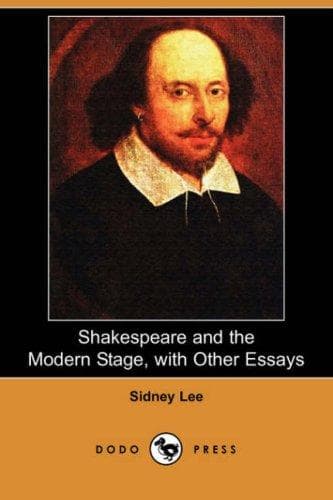
Shakespeare and the Modern Stage; with Other EssaysLee, Sidney, Sir
History
Shakespeare and the Modern Stage; with Other Essays
Lee, Sidney, Sir
Shakespeare, William, 1564-1616; Shakespeare, William, 1564-1616 -- Stage history
Pepys's moderate praise and immoderate blame of Shakespeare are only
superficially puzzling. The ultimate solution is not difficult.
Despite his love of music and his zeal as a collector, Pepys was the
most matter-of-fact of men; he was essentially a man of business. Not
that he had any distaste for timely recreation; he was, indeed,
readily susceptible to every manner of commonplace pleasures--to all
the delights of both mind and sense which appeal to the practical and
hard-headed type of Englishman. Things of the imagination, on the
other hand, stood with him on a different footing. They were out of
his range or sphere. Poetry and romance, unless liberally compounded
with prosaic ingredients, bored him on the stage and elsewhere.
In the plays of Beaumont and Fletcher, of Massinger and Ben Jonson,
poetry and romance were for the most part kept in the background. Such
elements lay there behind a substantial barrier of conventional stage
machinery and elocutionary scaffolding. In Shakespeare, poetry and
romance usually eluded the mechanical restrictions of the theatre.
The gold had a tendency to separate itself from the alloy, and Pepys
only found poetry and romance endurable when they were pretty thickly
veiled behind the commonplaces of rhetoric or broad fun or the
realistic ingenuity of the stage carpenter and upholsterer.
There is, consequently, no cause for surprise that Pepys should write
thus of Shakespeare's ethereal comedy of _A Midsummer Night's Dream_:
"Then to the King's Theatre, where we saw _A Midsummer Night's Dream_,
which I had never seen before, nor shall ever again, for it is the
most insipid, ridiculous play that ever I saw in my life. I saw, I
confess, some good dancing and some handsome women, which was all my
pleasure." This is Pepys's ordinary attitude of mind to undiluted
poetry on the stage.
Pepys only saw _A Midsummer Night's Dream_ once. _Twelfth Night_, of
which he wrote in very similar strains, he saw thrice. On the first
occasion his impatience of this romantic play was due to external
causes. He went to the theatre "against his own mind and resolution."
He was over-persuaded to go in by a friend, with whom he was casually
walking past the house in Lincoln's Inn Fields. Moreover, he had just
sworn to his wife that he would never go to a play without her: all
which considerations "made the piece seem a burden" to him. He
witnessed _Twelfth Night_ twice again in a less perturbed spirit, and
then he called it a "silly" play, or "one of the weakest plays that
ever I saw on the stage."
Again, of _Romeo and Juliet_, Pepys wrote: "It is a play of itself the
worst I ever heard in my life." This verdict, it is right to add, was
attributable, in part at least, to Pepys's irritation at the badness
of the acting, and at the actors' ignorance of their words. It was a
first night.
Public-domain text, read in full here on John Shaqi.
Reviews
Reviews
No reviews yet
Be the first to share your thoughts on this work.
Elsewhere in the archive
Join the Discussion
Join the discussion
Sign in to leave a comment or review.
Sign InorCreate an account