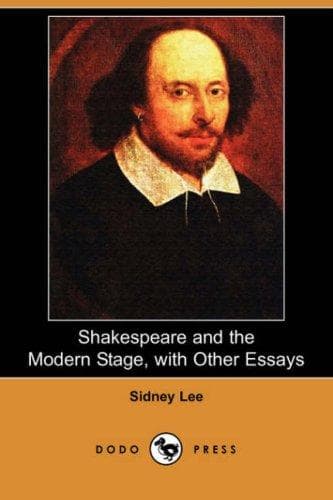
Shakespeare and the Modern Stage; with Other EssaysLee, Sidney, Sir
History
Shakespeare and the Modern Stage; with Other Essays
Lee, Sidney, Sir
Shakespeare, William, 1564-1616; Shakespeare, William, 1564-1616 -- Stage history
Pepys fully approved the innovations, and two of the earliest of
Shakespearean adaptations won his unqualified eulogy. These were
D'Avenant's reconstructions of _The Tempest_ and _Macbeth._ D'Avenant
had convinced himself that both plays readily lent themselves to
spectacle; they would repay the embellishments of ballets, new songs,
new music, coloured lights, and flying machines. Reinforced by these
charms of novelty, the old pieces might enjoy an everlasting youth. No
spectator more ardently applauded such bastard sentiment than the
playgoing Pepys.
Of the two pieces, the text of _Macbeth_ was abbreviated, but
otherwise the alterations in the blank-verse speeches were
comparatively slight. Additional songs were provided for the Witches,
together with much capering in the air. Music was specially written by
Matthew Locke. The liberal introduction of song and dance rendered the
piece, in Pepys's strange phrase, "a most excellent play for variety."
He saw D'Avenant's version of it no less than eight times, with
ever-increasing enjoyment. He generously praised the clever
combination of "a deep tragedy with a divertissement." He detected no
incongruity in the amalgamation. "Though I have seen it often," he
wrote later, "yet is it one of the best plays for a stage, and for
variety of dancing and music, that ever I saw."
_The Tempest_, the other adapted play, which is prominent in Pepys's
diary, underwent more drastic revision. Here D'Avenant had the
co-operation of Dryden; and no intelligent reader can hesitate to
affirm that the ingenuity of these worthies ruined this splendid
manifestation of poetic fancy and insight. It is only fair to Dryden
to add that he disclaimed any satisfaction in his share in the
outrage. The first edition of the barbarous revision was first
published in 1670, after D'Avenant's death, and Dryden wrote a
preface, in which he prudently remarked: "I do not set a value on
anything I have written in this play but [_i.e._, except] out of
gratitude to the memory of Sir William Davenant, who did me the honour
to join me with him in the alteration of it."
The numerous additions, for which the distinguished coadjutors are
responsible, reek with mawkish sentimentality, inane vapidity, or
vulgar buffoonery. Most of the leading characters are duplicated or
triplicated. Miranda has a sister, Dorinda, who is repellently
coquettish. This new creation finds a lover in another new character,
a brainless youth, Hippolito, who has never before seen a woman.
Caliban becomes the most sordid of clowns, and is allotted a sister,
Milcha, who apes his coarse buffoonery. Ariel, too, is given a female
associate, Sycorax, together with many attendants. The sailors are
increased in number, and a phalanx of dancing devils join in their
antics.
Public-domain text, read in full here on John Shaqi.
Reviews
Reviews
No reviews yet
Be the first to share your thoughts on this work.
Elsewhere in the archive
Join the Discussion
Join the discussion
Sign in to leave a comment or review.
Sign InorCreate an account