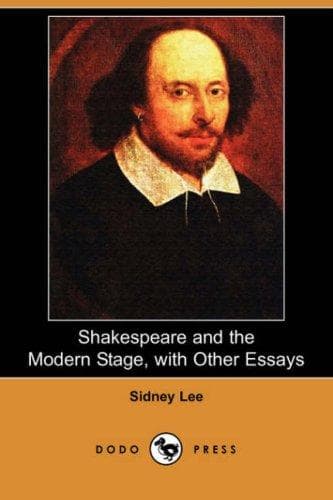
Shakespeare and the Modern Stage; with Other Essays — John Shaqi
Shakespeare and the Modern Stage; with Other EssaysLee, Sidney, Sir
History
Shakespeare and the Modern Stage; with Other Essays
Lee, Sidney, Sir
Shakespeare, William, 1564-1616; Shakespeare, William, 1564-1616 -- Stage history
Effective suggestion of the scene of _The Tempest_ is all that can be
reasonably attempted or desired. Plays which are wrought of purest
imaginative texture call solely for a scenic setting which should
convey effective suggestion. The machinery to be employed for the
purpose of effective suggestion should be simple and unobtrusive. If
it be complex and obtrusive, it defeats "the purpose of playing" by
exaggerating for the spectator the inevitable interval between the
visionary and indeterminate limits of the scene which the poet
imagines, and the cramped and narrow bounds, which the stage renders
practicable. That perilous interval can only be effectually bridged
by scenic art, which is applied with an apt judgment and a light hand.
Anything that aims at doing more than satisfy the condition essential
to the effective suggestion of the scenic environment of Shakespearean
drama is, from the literary and logical points of view, "wasteful and
ridiculous excess."[2]
[Footnote 2: A minor practical objection, from the dramatic point of
view, to realistic scenery is the long pause its setting on the stage
often renders inevitable between the scenes. Intervals of the kind,
which always tends to blunt the dramatic point of the play, especially
in the case of tragic masterpieces, should obviously be as brief as
possible.]
But it is not only a simplification of scenic appliances that is
needed. Other external incidents of production require revision.
Spectacular methods of production entail the employment of armies of
silent supernumeraries to whom are allotted functions wholly
ornamental and mostly impertinent. Here, too, reduction is desirable
in the interest of the true significance of drama. No valid reason can
be adduced why persons should appear on the stage who are not
precisely indicated by the text of the play or by the authentic stage
directions. When Caesar is buried, it is essential to produce in the
audience the illusion that a crowd of Roman citizens is taking part in
the ceremony. But quality comes here before quantity. The fewer the
number of supernumeraries by whom the needful illusion is effected,
the greater the merit of the performance, the more convincing the
testimony borne to the skill of the stage-manager. Again, no
processions of psalm-singing priests and monks contribute to the
essential illusion in the historical plays. Nor does the text of _The
Merchant of Venice_ demand any assembly of Venetian townsfolk,
however picturesquely attired, sporting or chaffering with one another
on the Rialto, when Shylock enters to ponder Antonio's request for a
loan. An interpolated tableau is indefensible, and "though it make the
unskilful laugh, cannot but make the judicious grieve." In _Antony and
Cleopatra_ the pageant of Cleopatra's voyage up the river Cydnus to
meet her lover Antony should have no existence outside the gorgeous
description given of it by Enobarbus.
III
Public-domain text, read in full here on John Shaqi.
Reviews
Reviews
No reviews yet
Be the first to share your thoughts on this work.
Join the Discussion
Join the discussion
Sign in to leave a comment or review.
Sign InorCreate an account