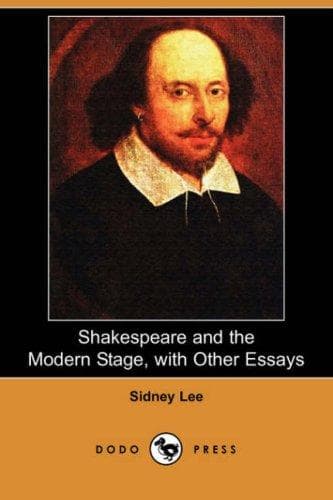
Shakespeare and the Modern Stage; with Other EssaysLee, Sidney, Sir
History
Shakespeare and the Modern Stage; with Other Essays
Lee, Sidney, Sir
Shakespeare, William, 1564-1616; Shakespeare, William, 1564-1616 -- Stage history
The benefits to be derived from the control of a trained school of
Shakespearean actors were displayed very conspicuously when Mr Benson
undertook six years ago the heroic task of performing the play of
_Hamlet_, as Shakespeare wrote it, without any abbreviation. _Hamlet_
is the longest of Shakespeare's plays; it reaches a total of over 3900
lines. It is thus some 900 lines longer than _Antony and Cleopatra_,
which of all Shakespeare's plays most nearly approaches its length.
Consequently it is a tradition of the stage to cut the play of
_Hamlet_ by the omission of more than a third. Hamlet's part is
usually retained almost in its entirety, but the speeches of every
other character are seriously curtailed. Mr Benson ventured on the
bold innovation of giving the play in full.[22]
[Footnote 22: The performance occupied nearly six hours. One half was
given in the afternoon, and the other half in the evening of the same
day, with an interval of an hour and a half between the two sections.
Should the performance be repeated, I would recommend, in the
interests of busy men and women, that the whole play be rendered at a
single sitting, which might be timed to open at a somewhat earlier
hour in the evening than is now customary, and might, if need be,
close a little later. There should be no difficulty in restricting the
hours occupied by the performance to four and a half.]
Only he who has witnessed the whole play on the stage can fully
appreciate its dramatic capabilities. It is obvious that, in whatever
shape the play of _Hamlet_ is produced in the theatre, its success
must always be primarily due to the overpowering fascination exerted
on the audience by the character of the hero. In every conceivable
circumstance the young prince must be the centre of attraction.
Nevertheless, no graver injury can be done the play as an acting drama
than by treating it as a one-part piece. The accepted method of
shortening the tragedy by reducing every part, except that of Hamlet,
is to distort Shakespeare's whole scheme, to dislocate or obscure the
whole action. The predominance of Hamlet is exaggerated at the expense
of the dramatist's artistic purpose.
To realise completely the motives of Hamlet's conduct, and the process
of his fortunes, not a single utterance from the lips of the King,
Polonius, or Laertes can be spared. In ordinary acting versions these
three parts sink into insignificance. It is only in the full text that
they assume their just and illuminating rank as Hamlet's foils.
The King rises into a character almost of the first class. He is a
villain of unfathomable infamy, but his cowardly fear of the discovery
of his crimes, his desperate pursuit of the consolations of religion,
the quick ingenuity with which he plots escape from the inevitable
retribution that dogs his misdeeds, excite--in the full text of the
play--an interest hardly less intense than those wistful musings of
the storm-tossed soul which stay his nephew's avenging hand.
Public-domain text, read in full here on John Shaqi.
Reviews
Reviews
No reviews yet
Be the first to share your thoughts on this work.
Elsewhere in the archive
Join the Discussion
Join the discussion
Sign in to leave a comment or review.
Sign InorCreate an account