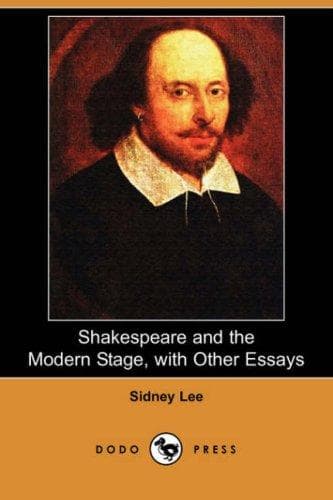
Shakespeare and the Modern Stage; with Other EssaysLee, Sidney, Sir
History
Shakespeare and the Modern Stage; with Other Essays
Lee, Sidney, Sir
Shakespeare, William, 1564-1616; Shakespeare, William, 1564-1616 -- Stage history
Of those who have written recently in favour of the scheme of a
municipal theatre many speak with the authority of exceptional
experience. The actor Mr John Coleman, one of the last survivors of
Phelps's company at Sadler's Wells Theatre, argued with cogency,
shortly before his death in 1903, that the national credit owed it to
itself to renew Phelps's experiment of the middle of last century;
public intervention was imperative, seeing that no other means were
forthcoming. The late Sir Henry Irving in his closing years announced
his conviction that a municipal theatre could alone keep the classical
and the poetic drama fully alive in the theatres. The dramatic critic
Mr William Archer, has brought his expert knowledge of dramatic
organisation at home and abroad to the aid of the agitation. Various
proposals--unhappily of too vague and unauthoritative a kind to
guarantee a satisfactory reception--have been made from time to time
to raise a fund to build a national theatre, and to run it for five
years on a public subsidy of L10,000 a year.
The advocates of the municipalising principle have worked for the most
part in isolation. Such independence tends to dissipate rather than
to conserve energy. A consolidating impulse has been sorely needed.
But the variety of the points of views from which the subject has been
independently approached renders the less disputable the genuine width
of public interest in the question.
The argument that it is contrary to public policy, or that it is
opposed to the duty of the State or municipality, to provide for the
people's enlightened amusement, is not formidable. The State and the
municipality have long treated such work as part of their daily
functions, whatever the arguments that have been urged against it. The
State, in partnership with local authorities, educates the people,
whether they like it or no. The municipalities of London and other
great towns provide the people, outside the theatre, with almost every
opportunity of enlightenment and enlightened amusement. In London
there are 150 free libraries, which are mainly occupied in providing
the ratepayers with the opportunities of reading fiction--recreation
which is not always very enlightened. The County Council of London
furnishes bands of music to play in the parks, at an expenditure of
some L6000 a year. Most of our great cities supply, in addition,
municipal picture galleries, in which the citizens take pride, and to
which in their corporate capacity they contribute large sums of money.
The municipal theatre is the natural complement of the municipal
library, the municipal musical entertainment, and the municipal art
gallery.
V
Public-domain text, read in full here on John Shaqi.
Reviews
Reviews
No reviews yet
Be the first to share your thoughts on this work.
Elsewhere in the archive
Join the Discussion
Join the discussion
Sign in to leave a comment or review.
Sign InorCreate an account