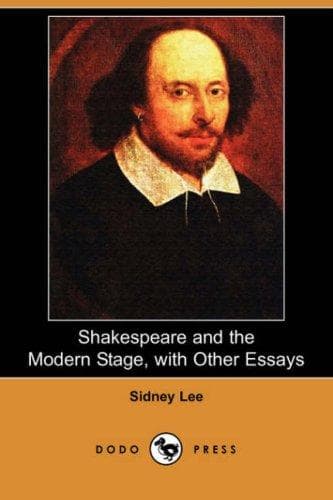
Shakespeare and the Modern Stage; with Other EssaysLee, Sidney, Sir
History
Shakespeare and the Modern Stage; with Other Essays
Lee, Sidney, Sir
Shakespeare, William, 1564-1616; Shakespeare, William, 1564-1616 -- Stage history
The success of the Volks-Theater is due to the co-operation of a
public body with a voluntary society of private citizens who regard
the maintenance of the literary drama as a civic duty. The site of the
Volks-Theater, which was formerly public property and estimated to be
worth L80,000, is in the best part of the city of Vienna. It was a
free gift from the government to a limited liability company, formed
of some four hundred shareholders of moderate means, who formally
pledged themselves to erect on the land a theatre with the sole object
of serving the purposes of dramatic art. The interest payable to
shareholders is strictly limited by the conditions of association. An
officially sanctioned constitution renders it obligatory on them and
on their officers to produce in the playhouse classical and modern
drama of a literary character, though not necessarily of the severest
type. Merely frivolous or spectacular pieces are prohibited, and at
least twice a week purely classical plays must be presented. No piece
may be played more than two nights in immediate succession. The
actors, whose engagements are permanent, are substantially paid, and
an admirably devised system of pensions is enforced without making
deductions from salaries. The price of seats is fixed at a low rate,
the highest price being 4s., the cheapest and most numerous seats
costing 10d. each. Both financially and artistically the result has
been all that one could wish. There is no public subsidy, but the
Emperor pays L500 a year for a box. The house holds 1800 persons,
yielding gross receipts of L200 for a nightly expenditure of L125.
There are no advertising expenses, no posters. The newspapers give
notice of the daily programme as an attractive item of news.
VI
There is some disinclination among Englishmen deliberately to adopt
foreign methods, to follow foreign examples, in any walk of life. But
no person of common sense will reject a method merely because it is
foreign, if it can be proved to be of utility. It is spurious
patriotism to reject wise counsel because it is no native product. On
the other hand, it is seriously to asperse the culture and
intelligence of the British nation to assume that no appreciable
section of it cherishes that taste for the literary drama which keeps
the national or municipal theatre alive in France and Germany. At any
rate, judgment should be held in suspense until the British playgoers'
mettle has been more thoroughly tested than hitherto.
Public-domain text, read in full here on John Shaqi.
Reviews
Reviews
No reviews yet
Be the first to share your thoughts on this work.
Elsewhere in the archive
Join the Discussion
Join the discussion
Sign in to leave a comment or review.
Sign InorCreate an account