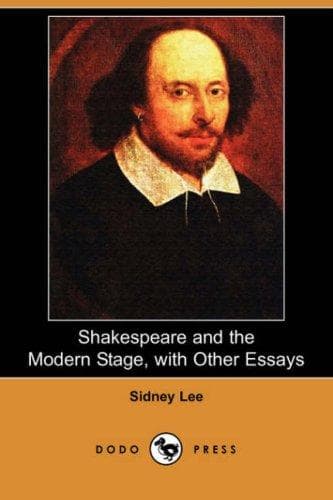
Shakespeare and the Modern Stage; with Other EssaysLee, Sidney, Sir
History
Shakespeare and the Modern Stage; with Other Essays
Lee, Sidney, Sir
Shakespeare, William, 1564-1616; Shakespeare, William, 1564-1616 -- Stage history
Phelps's single-handed effort brought the people of London for
eighteen years face to face with the great English drama at his
playhouse at Sadler's Wells. "I made that enterprise pay," he said,
after he retired; "not making a fortune certainly, but bringing up a
large family and paying my way." Private troubles and illness
compelled him suddenly to abandon the enterprise at the end of
eighteen years, when there happened to be none at hand to take his
place of leader. All that was wanting to make his enterprise
permanent, he declared, was some public control, some public
acknowledgment of responsibility which, without impeding the efficient
manager's freedom of action, would cause his post to be filled
properly in case of an accidental vacancy. Phelps thought that if he
could do so much during eighteen years by his personal, isolated, and
independent endeavour, much more could be done in permanence under
some public method of safeguard and guarantee. Phelps's services to
the literary drama can hardly be over-estimated. His mature judgment
is not to be lightly gainsaid. It is just to his memory to put his
faith to a practical test.
VII
ASPECTS OF SHAKESPEARE'S PHILOSOPHY[24]
[Footnote 24: This paper, which was originally prepared in 1899 for
the purposes of a popular lecture, is here printed for the first
time.]
I
A French critic once remarked that a whole system of philosophy could
be deduced from Shakespeare's pages, though from all the works of the
philosophers one could not draw a page of Shakespeare. The second
statement--the denial of the presence of a page of Shakespeare in the
works of all the philosophers--is more accurate than the assertion
that a system of philosophy could be deduced from the plays of
Shakespeare. It is hopeless to deduce any precise system of philosophy
from Shakespeare's plays. Literally, philosophy means nothing more
recondite than love of wisdom. Technically, it means scientifically
restrained speculation about the causes of human thought and conduct;
it embraces the sciences of logic, of ethics, of politics, of
psychology, of metaphysics. Shakespeare's training and temper unfitted
him to make any professed contribution to any of these topics.
Ignorant persons argue on hazy grounds that the great avowed
philosopher of Shakespeare's day, Francis Bacon, wrote Shakespeare's
plays. There is no need to confute the theory, which confutes itself.
But, if a confutation were needed, it lies on the surface in the
conflicting attitudes which Shakespeare and Bacon assume towards
philosophy. There is no mistaking Bacon's attitude. The supreme aim of
his writings was to establish the practical value, the majestic
importance, of philosophy in its strict sense of speculative science.
He sought to widen its scope, and to multiply the ranks of its
students.
Public-domain text, read in full here on John Shaqi.
Reviews
Reviews
No reviews yet
Be the first to share your thoughts on this work.
Elsewhere in the archive
Join the Discussion
Join the discussion
Sign in to leave a comment or review.
Sign InorCreate an account