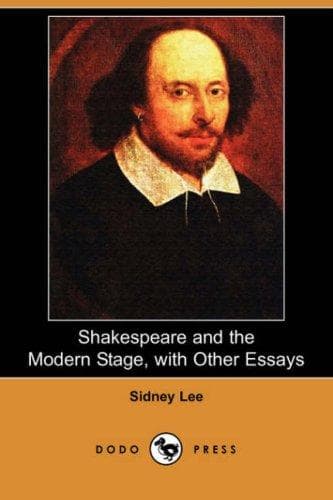
Shakespeare and the Modern Stage; with Other EssaysLee, Sidney, Sir
History
Shakespeare and the Modern Stage; with Other Essays
Lee, Sidney, Sir
Shakespeare, William, 1564-1616; Shakespeare, William, 1564-1616 -- Stage history
Bacon's method is formally philosophic in texture. He carefully
scrutinises, illustrates, seeks to justify each statement before
proceeding to a conclusion. Every essay, every treatise of Bacon,
conveys the impression not merely of weighty, pregnant eloquence, but
of the argumentative and philosophic temper. Bacon's process of
thinking is conscious: it is visible behind the words. The argument
progresses with a cumulative force. It draws sustenance from the
recorded opinions of others. The points usually owe consistency and
firmness to quotations from old authors--Greek and Latin authors,
especially Plato and Plutarch, Lucretius and Seneca. To Bacon, as to
all professed students of the subject, philosophy first revealed
itself in the pages of the Greek writers, Plato and Aristotle, the
founders for modern Europe of the speculative sciences of human
thought and conduct. Greatly as Bacon modified the Greek system of
philosophy, he began his philosophic career under the influence of
Aristotle, and, despite his destructive criticism of his master, he
never wholly divested himself of the methods of exposition to which
the Greek philosopher's teaching introduced him.
In their attitudes to philosophy, Shakespeare and Bacon are as the
poles asunder. Shakespeare practically ignores the existence of
philosophy as a formal science. He betrays no knowledge of its Greek
origin and developments.
There are two short, slight, conventional mentions of Aristotle's name
in Shakespeare's works. One is a very slight allusion to Aristotle's
"checks" or "moral discipline" in _The Taming of the Shrew_. That
passage is probably from a coadjutor's pen. In any case, it is merely
a playful questioning of the title of "sweet philosophy" to monopolize
a young man's education.[25]
[Footnote 25: Tranio, the attendant on the young Pisan, Lucentio, who
has come to Padua to study at the university, counsels his master to
widen the field of his studies:--
Only, good master, while we do admire
This virtue and this moral discipline,
Let's be no Stoics, nor no stocks, I pray,
Or so devote to _Aristotle's checks_,
As Ovid be an outcast quite adjured.
(_The Taming of the Shrew_, I., ii., 29-33.)]
Public-domain text, read in full here on John Shaqi.
Reviews
Reviews
No reviews yet
Be the first to share your thoughts on this work.
Elsewhere in the archive
Join the Discussion
Join the discussion
Sign in to leave a comment or review.
Sign InorCreate an account