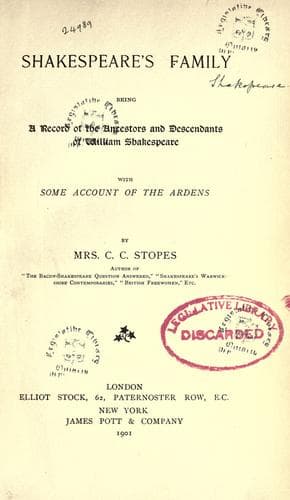
Shakespeare's familyStopes, C. C. (Charlotte Carmichael)
History
Shakespeare's family
Stopes, C. C. (Charlotte Carmichael)
Arden family; Shakespeare family; Shakespeare, William, 1564-1616 -- Family
[43] Yeatman's "Gentle Shakespeare," pp. 138-142.
[44] Court Rolls, General Series, Portfolio 207, No. 99.
[45] Addit. MSS., Brit. Mus. (24,500).
[46] Mr. Yeatman's "Gentle Shakespeare," p. 142.
[47] Court Roll, No. 10, p. 207.
[48] Nash's "Worcestershire," vol. ii., account of Tardebigg. See
Augmentation Books, October 14, 1539, 233, f. 8.
[49] Hunter's "Prolusions," p. 9.
[50] Wood's Colleges. Fasti Oxoniensis, Bliss, 1815. Wood, Antiq. Oxon.,
L. 2, 341. Boase, Reg. Univ. Oxon. Newcourt's "Repertorium."
CHAPTER IV
THE SHAKESPEARE COAT OF ARMS
[Illustration: NON SANZ DROICT.]
None of the family seem to have risen above the heraldic horizon till
John Shakespeare applied for his coat of arms. Into the contest over
that application it is well to plunge at once, and thence work backwards
and forwards. Four classes of writers wage war over the facts: the
Baconians, like the late Mr. Donnelly, who deny everything; the
Romanticists, who accept what is pleasant, and occasionally believe
manufactured tradition to suit their inclinations; the agnostic
Shakespeareans, like Halliwell-Phillipps, who really work, but believe
only what they can see and touch, if it accords with their opinions; and
the ingenuous workers who seek saving truth like the agnostics, but
bring human influences and natural inferences to bear on dusty records.
Now, Halliwell-Phillipps does not scruple to affirm that three
heralds,[51] the worthy ex-bailiff of Stratford, and the noblest poet
the world has ever produced, were practically liars in this matter,
because they make statements that do not harmonize with the limits of
his knowledge and the colour of his opinions. From his grave the poet
protests--
"Good name in man or woman, dear my lord,
Is the immediate jewel of their souls.
Who steals my purse steals trash....
But he who filches from me my good name
Robs me of that, which not enriches him,
But leaves me poor indeed."
_Othello_, Act III., Scene 3.
Public-domain text, read in full here on John Shaqi.
Reviews
Reviews
No reviews yet
Be the first to share your thoughts on this work.
Join the Discussion
Join the discussion
Sign in to leave a comment or review.
Sign InorCreate an account