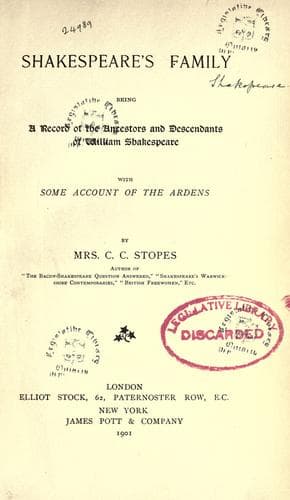
Shakespeare's familyStopes, C. C. (Charlotte Carmichael)
History
Shakespeare's family
Stopes, C. C. (Charlotte Carmichael)
Arden family; Shakespeare family; Shakespeare, William, 1564-1616 -- Family
Nobody now knows anything of that earlier pattern, nor of the patents of
the gifts "to the antecessors." But seeing, as I have seen, that sacks
full of old parchment deeds and bonds, reaching back to the fifteenth
century, get cleared out of lawyers' offices, and sold for small sums to
make drumheads or book-bindings, and seeing that this process has been
going on for 400 years, it does not seem to me surprising that some
deeds do get lost. Generally, it is those we most wish to have that
disappear. Lawyers do not, as a rule, concern themselves with historical
fragments, but with the soundness of the present titles of their clients
and their own modern duties. (I do think that historical and antiquarian
societies should bestir themselves to have old deeds included among the
"ancient monuments of the country" and entitled to some degree of
protection.)
We must also consider how illiterate the inhabitants of the country were
in the reign of Henry VII., how the nation was bestrid by officials of
the Empson and Dudley type, and we have reason to believe that various
accidents, intentional or otherwise, caused many an old grant to
disappear at that period.
It has struck me as possible that John Shakespeare may have intended
ancestors through the female line. The names of his mother and
grandmother are as yet unknown, and the supposition has never been
discussed. But in support of John Shakespeare's claim, and in opposition
to Halliwell-Phillipps's contradiction, we can prove there _were_
Shakespeares in direct service of the Crown, not merely as common
soldiers, though in 28 Henry VIII. (1537), Thomas, Richard, William and
another Richard were mentioned as among the King's forces.[55]
But one Roger Shakespeare was Yeoman of the Chamber to the King, and on
June 9, 1552, shared with his fellows, Abraham Longwel and Thomas Best,
a forfeit of L36 10s.[56] This post of Yeoman of the Chamber was one of
great trust and dignity; it was the same as that held earlier by Robert
Arden, of Yoxall, the younger brother of Sir John Arden, and the
election to it suggested either inherited favour, Court interest, or
signal personal services. His ancestors might have been also the missing
ancestors of John Shakespeare. He himself may be the Roger who was
buried in Haseley in 1558, supposed by some to have been the monk of
Bordesley. He may also have been the father of Thomas Shakespeare, the
Royal Messenger of 1575, noticed later.
This record proves nothing beyond the inexactitude of
Halliwell-Phillipps's sweeping statements, but it gives us a hope that
something else may somewhere else be found to fit into it and make a
fact complete. One of the facts brought forward as a reason for the
grant of arms to John Shakespeare was "that he hath maryed Mary daughter
and one of the heires of Robert Arden in the same countie, Esquire."
"Gent" was originally written, and was altered to "Esquire."[57]
Public-domain text, read in full here on John Shaqi.
Reviews
Reviews
No reviews yet
Be the first to share your thoughts on this work.
Join the Discussion
Join the discussion
Sign in to leave a comment or review.
Sign InorCreate an account