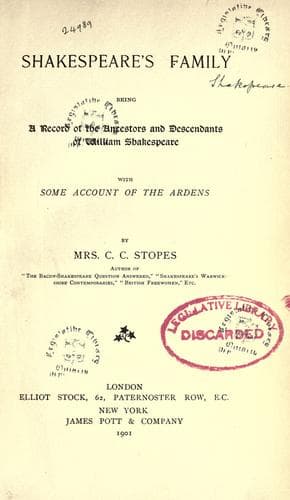
Shakespeare's familyStopes, C. C. (Charlotte Carmichael)
History
Shakespeare's family
Stopes, C. C. (Charlotte Carmichael)
Arden family; Shakespeare family; Shakespeare, William, 1564-1616 -- Family
English authors use it as an example of their theories. Verstegan
says[3]: "Breakspear, Shakespeare, and the like, have bin surnames
imposed upon the first bearers of them for valour and feates of armes;"
and Camden[4] also notes: "Some are named from that they carried, as
Palmer ... Long-sword, Broadspear, and in some respects Shakespear."
In "The Polydoron"[5] it is stated that "Names were first questionlesse
given for distinction, facultie, consanguinity, desert, quality ... as
Armestrong, Shakespeare, of high quality."
That it was so understood by his contemporaries we may learn from
Spenser's allusion, evidently intended for him, seeing no other poet of
his time had an "heroic name"[6]:
"And there, though last, not least is Aetion;
A gentler shepherd[7] may nowhere be found,
Whose Muse, full of high thought's invention,
Doth like himself heroically sound."
If the parts of the name be significant, I take it that the correct
spelling at any period is that of the contemporary spelling of the
parts. Therefore, when spear was spelt "spere," the cognomen should be
spelt "Shakespere"; when spear was spelt "speare," as it was in the
sixteenth century, the name should be spelt "Shakespeare." Other methods
of spelling depended upon the taste or education of the writers, during
transition periods, when they seemed actually to _prefer_ varieties, as
one sometimes finds a proper name spelt in three different ways by the
same writer on the same page. "Shakespeare" was the contemporary form of
the name that the author himself passed in correcting the proofs of the
"first heirs of his invention" in 1593 and 1594; and "Shakespeare" was
the Court spelling of the period, as may be seen by the first official
record of the name. When Mary, Countess of Southampton, made out the
accounts of the Treasurer of the Chamber after the death of her second
husband, Sir Thomas Heneage, in 1594, she wrote: "To William Kempe,
William Shakespeare,[8] and Richard Burbage," etc.
I know that Dr. Furnivall[9] wrote anathemas against those who dared to
spell the name thus, while the poet wrote it otherwise. But a man's
spelling of his own name counted very little then. He might have held
romantically to the quainter spelling of the olden time as many others
did, such as "Duddeley," "Crumwell," "Elmer."
[Illustration]
FOOTNOTES:
[1] _Notes and Queries_, 2nd Series, ix. 459, x. 15, 86, 122; 7th
Series, iv. 66; 8th Series, vii. 295; 5th Series, ii. 2.
[2] See Works of Goffredo di Crollalanza, Segretario-Archivista dell'
Accademia Araldica Italiana, which were brought to my notice by Dr.
Richard Garnett.
[3] Verstegan's "Restitution of Decayed Intelligence," ed. 1605, p. 254.
[4] Camden's "Remains," ed. 1605, p. 111.
[5] Undated, but contemporary. _Notes and Queries_, 3rd Series, i. 266.
[6] Spenser's "Colin Clout's Come Home Again," 1595.
[7] It was a fashion of the day to call all poets "shepherds."
Public-domain text, read in full here on John Shaqi.
Reviews
Reviews
No reviews yet
Be the first to share your thoughts on this work.
Join the Discussion
Join the discussion
Sign in to leave a comment or review.
Sign InorCreate an account