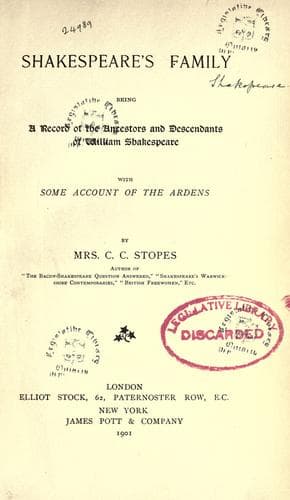
Shakespeare's familyStopes, C. C. (Charlotte Carmichael)
History
Shakespeare's family
Stopes, C. C. (Charlotte Carmichael)
Arden family; Shakespeare family; Shakespeare, William, 1564-1616 -- Family
Judith's death, at the age of seventy-seven, left Lady Elizabeth Barnard
the poet's sole survivor. She had no children by her second marriage,
about which we have no other detail. It has been surmised that it was
not a happy one. Sir John Barnard was a widower, and had already a
family. There is no mention of this family in Lady Barnard's will, and a
limitation to the barest law and justice towards her husband, whom she
did not leave her executor. The will was drawn up on January 29,
1669-70, and she died at Abington in February. "Madam Elizabeth Bernard,
wife of Sir John Bernard, Knight, was buried 17th Feb., 1669-70."[203]
No sepulchral monument was raised in memory of the granddaughter and
heir of Shakespeare, but she probably lay in the same tomb as her
husband, who died in 1674. A memorial slab still remains to his memory
in Abington Church, but the place of his burial is unknown, and the
vault below this stone is used by another family.
By his death his wife's will[204] came into force, written while she was
still "in perfect memory--blessed be God!--and mindful of mortality."
She recounted the settlement of April 18, 1653, to which the trustees
were Henry Smith, of Stratford, gent., and Job Dighton, of the Middle
Temple, London, Esquire. Henry Smith, her surviving trustee, or his
heirs, six months after the death of her husband, Sir John Barnard, was
to sell New Place, giving the first offer to her loving cousin, Edward
Nash, and the money was to be used in legacies. Her cousin, Thomas
Welles, of Carleton, in county Bedford, was to have L50 if he be alive,
and if he be dead, her kinsman, Edward Bagley, citizen of London, was to
receive the amount. How she was connected with these men I have been
unable to find out. "Judith Hathaway, one of the daughters of my
kinsman, Thomas Hathaway, late of Stratford," L5 a year or L40 in hand.
Unto Joane, the wife of Edward Kent, another daughter of the said Thomas
Hathaway, L50, failing whom to her heir, _Edward Kent the younger_, at
his coming of age. To this same Edward Kent she left L30 for his
apprenticeship. To Rose, Elizabeth, and Susanna, three other "daughters
of my kinsman, Thomas Hathaway, L40 a piece." Henry Smith was to have L5
for his pains, and Edward Bagley to be residuary legatee. "To my
kinsman, Thomas Hart, the son of Thomas Hart, late of Stratford, all
that my other messuage or Inne commonly called the Maydenhead, with the
next house thereto adjoining, with the barne belonging to the same, now
in the occupation of Michael Johnson; to Thomas Hart and his heirs,
failing whom to his brother George Hart and his heirs," failing whom to
her own right heirs for ever. She made her "loving kinsman Edward
Bagley" executor, "in witness of which I set my hand and seal." It may
be seen that she retained absolute power of the poet's purchases, but
justly left his inheritance from his father John to his sister's
descendants. But she did no more than justice.
Public-domain text, read in full here on John Shaqi.
Reviews
Reviews
No reviews yet
Be the first to share your thoughts on this work.
Elsewhere in the archive
Join the Discussion
Join the discussion
Sign in to leave a comment or review.
Sign InorCreate an account