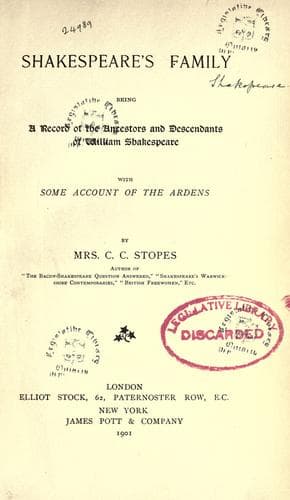
Shakespeare's familyStopes, C. C. (Charlotte Carmichael)
History
Shakespeare's family
Stopes, C. C. (Charlotte Carmichael)
Arden family; Shakespeare family; Shakespeare, William, 1564-1616 -- Family
It is not clear how the connection is traced between her and her other
legatees, but it is very noticeable her preference for the Hathaway
connections to those of the Shakespeare side.
Ere she died the poet's Blackfriars tenement had been reduced to ashes
in the Great Fire of 1666. What right in it or its site remained,
accrued to Edward Bagley, "citizen of London," her executor and
residuary legatee, who proved her will, March 4, 1669, though it is
stated to have been sold in Shakespeare's Biography in the Dictionary.
Edward Nash did not buy New Place, after all. It was bought by Sir
Edward Walker, at one time Secretary of War to Charles I., and then
Garter King-at-Arms. Halliwell-Phillipps states[205] it was sold by the
"surviving trustee," but Sir Edward Walker's own will[206] puts it a
little differently. He left to his dear daughter Barbara, wife of Sir
John Clopton, various bequests, among which appear "A yarde land in
Stratford field I bought of _Mr. Hall_, of the value of L12 10s. by year
... fyftly Land I bought of Sir John Clopton in the mannor of Clopton,
of the yearely value of L10. Sixtly 4 yard land lying in Stratford and
Bishopton fields which I bought of _Mr. Bagley_, and a house called the
New Place, situated in the Towne of Stratford upon Avon, of the yearely
value about fyfty fyve pounds ... my deare daughter and her husband Sir
John Clopton, sole executors, 30th June, 1676." He died early the
following year, and his will was proved March 10, 1676-77.
Thus, the property Shakespeare had put together became dispersed shortly
after his family became extinct, and New Place came back to the heirs of
the Cloptons, from whom it was purchased. I had hoped we might find
something from the will of Edward Bagley, but he died intestate,[207]
and the administration mentions nothing of interest to Shakespeare.
It is therefore quite clear that the whole period covered by
Shakespeare's life and that of his descendants was 105 years, _i.e._,
from 1564 to 1669, and that _no lineal descendants can survive_. Yet, as
if in illustration of the methods of fabrication of tradition, when it
is desired, I have heard of many of the name who boast a _lineal descent
from the poet_; and of one even who boasts of having inherited not only
_the Shakespeare's_ dinner-service, but his _teapot_! Yet that the
presence of the name is a certain bar to the descent, as above shown, no
such claimants seem to have taken the trouble to find out, as they
easily might do. I am told that in Verona, by the tomb of Romeo and
Juliet, a modern visitor has described himself as "Shakespeare,
_descendant_ of the poet who wrote the play." William Shakespeare's
poems alone are his posterity.
Public-domain text, read in full here on John Shaqi.
Reviews
Reviews
No reviews yet
Be the first to share your thoughts on this work.
Elsewhere in the archive
Join the Discussion
Join the discussion
Sign in to leave a comment or review.
Sign InorCreate an account