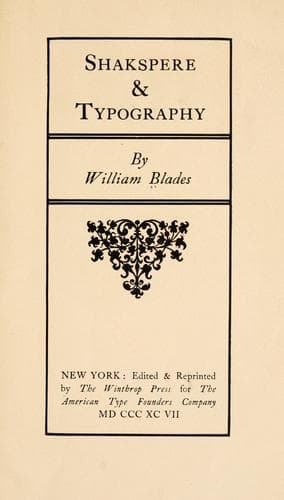
Shakespeare, William, 1564-1616 -- Knowledge -- Book industries and trade
If a book is folio, and two pages of type have been composed, they are
placed in proper position upon the imposing stone, and enclosed within an
iron or steel frame called a 'chase', small wedges of hard wood termed
'coigns' or 'quoins' being driven in at opposite sides to make all tight.
By the four opposing coigns,
Which the world together joins.
_Pericles_, iii, 1.
This is just the description of a forme in folio where two quoins on one
side are always opposite to two quoins on the other, thus together
joining and tightening all the separate stamps. In a quaint allegorical
poem, published anonymously about the year 1700, in which the mystery of
man's redemption is symbolised by the mystery of Printing, the author
commences thus:
Great blest Master Printer, come
Into thy Composing-room;
and after 'spiritualising' the successive operations of the workman thus
touches upon the quoins:
Let the Quoins be thy sure Election,
Which admits of no Rejection;
With which our Souls being joined about,
Not the least Grace can then fall out.
Here, the idea of joining together by quoins so that nothing shall fall
out, is just the same as in the couplet quoted from Shakspere.
The tightening of these quoins by means of a wooden-headed mallet,
(There is no more conceit in him than is in a mallet,
_2 Henry IV_, ii, 4),
is called 'locking up', an exclusively technical term. The expression,
however, occurs in 'Measure for Measure', IV, 2,
Fast locked up in sleep,
where the idea conveyed is the same.
The 'Forme' worked off and the metal chase removed, leaving the pages
'naked', affords the Poet the following simile, which although not
carrying to the popular ear any typographical meaning, was doubtless
suggested by Shakspere's former experience of the workshop:
And he but _naked_ though _locked up_ in steel.
_2 Henry VI_, iii, 2.
The primary idea of 'locking up' had, doubtless, reference to 'armour';
the secondary to printing, as shown by the use of the word 'naked'.
The forme then went to the Press-room, where considerable ingenuity was
required to make 'register'; that is, to print one side so exactly upon
the other, that when the sheet was held up to the light the lines on each
side would exactly back one another. The accuracy of judgment required for
this is thus glanced at:
_Eno._ But let the world rank me in _register_
A master-leaver and a fugitive.
_Antony and Cleopatra_, iv, 9.
When the green-eyed Othello takes his wife's hand and exclaims:
Here's a young and sweating devil,
_Othello_, iii, 4,
Public-domain text, read in full here on John Shaqi.
Reviews
Reviews
No reviews yet
Be the first to share your thoughts on this work.
Join the Discussion
Join the discussion
Sign in to leave a comment or review.
Sign InorCreate an account