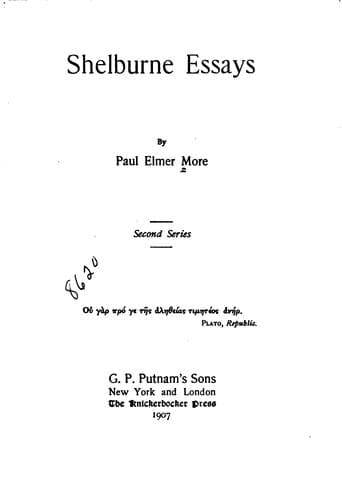
American literature -- History and criticism; English literature -- History and criticism
Here, then, in the library of his compromising friend, he gathered the
material for his great work, _Tristram Shandy_; and, indeed, if we
credit some scholars, he gathered so successfully that little was left
for his own creative talents. It is demonstrably true that he made
extraordinary use of certain old French books, including Rabelais, whom
he counted with Cervantes as his master; and from Burton's _Anatomy of
Melancholy_ he borrowed unblushingly, not to mention other English
authors. We are shocked at first to learn that some of his choicest
passages are stolen goods; the recording angel's tear was shed, it
appears, and my Uncle Toby's fly was released long before that gentleman
was born to sweeten the world; so too the wind was tempered to the shorn
lamb in proverb before Sterne ever added that text to the stock of
biblical quotations. But after all, there is little to be gained by
unearthing these plagiarisms. _Tristram Shandy_ and the _Sentimental
Journey_ still remain among the most original productions in the
language, and we are only taught once more that genius has a high-handed
way of taking its own where it finds it.
The fact is that this trick of borrowing scarcely does more than affect
a few of those set pieces or purple patches by which an author like
Sterne gradually comes to be known and judged. These are admirably
adapted for use in anthologies, for they may be severed from their
context without cutting a single artery or nerve; but let no one suppose
that from reading them he gets anything but a distorted view of Sterne's
work. They are all marked by a peculiar kind of artificial pathos--the
recording angel's tear, Uncle Toby's fly, the dead ass, the caged
starling, Maria of Moulines (I name them as they occur to me)--and they
give a very imperfect notion of the true Shandean flavour. In their own
genre they are no doubt masterpieces, but it is a genre which gives
pleasure from the perception of the art, and not from the kindling touch
of nature, in their execution. They are ostensibly pathetic, yet they
make no appeal to the heart, and I doubt if a tear was ever shed over
any of them--even by the lachrymose Yorick himself. To enjoy them
properly one must key his mind to that state in which the emotions cease
to have validity in themselves, and are changed into a kind of exquisite
convention. Now, it is easier by far to detect the inherent
insubstantiality of such a convention than to appreciate its delicately
balanced beauty, and thus it happens that we hear so much of Sterne's
false sentiment from those who base their criticism primarily on these
famous episodes. For my part I am almost inclined to place the story of
Le Fevre in this class, and to wonder if those who call it pathetic
really mean that it has touched their heart; I am sure it never cost me
a sigh.
Public-domain text, read in full here on John Shaqi.
Reviews
Reviews
No reviews yet
Be the first to share your thoughts on this work.
Elsewhere in the archive
Join the Discussion
Join the discussion
Sign in to leave a comment or review.
Sign InorCreate an account