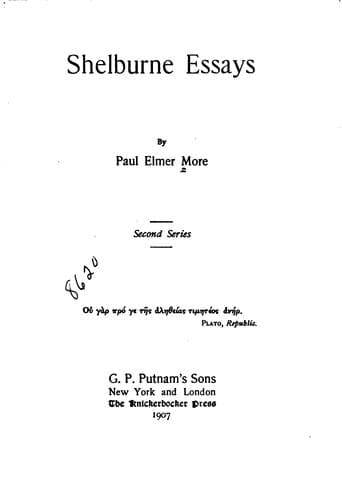
American literature -- History and criticism; English literature -- History and criticism
No, the highest mastery of Sterne does not lie in these anthological
patches, but first of all in his power of creating characters. There are
not many persons engaged in the little drama of Shandy Hall, and their
range of action is narrow, but they are drawn with a skill and a
memorable distinctness which have never been surpassed. Not the bustling
people of Shakespeare's stage are more real and individual than Mr.
Shandy, my Uncle Toby, Corporal Trim, and Dr. Slop. Even the minor
characters of the servants' hall are sketched in with wonderful
vividness; and if there is a single failure in all that gallery of
portraits, it is Yorick himself, who was drawn from the author and is
foisted upon the company somewhat unceremoniously, if truth be told. Nor
is the secret of their lifelikeness hard to discern. One of the constant
creeds of the age, handed down from the old comedy of humours, was the
belief in the "ruling passion" as the source of all a man's acts. The
persons who figure in most of the contemporary letters and novels are a
succession of originals or grotesques, moved by a single motive. They
are all mad in England, said Hamlet, and Walpole enforces the sentence
with a thousand burlesque anecdotes. Now in Sterne this ruling passion,
both in his own character and in that of his creations, was softened
down to what may be called a whimsical egotism, which does not repel by
its exaggeration, yet bestows a marvellous unity and relief. It is his
_hobbyhorsical_ philosophy, as he calls it. At the head of all are
Tristram's father and uncle, with their cunningly contrasted
humours--Mr. Shandy, who would regulate all the affairs of life by
abstract theorems of the mind, and my Uncle Toby, who is guided solely
by the impulses of the heart. Between them Sterne would seem to have set
over against each other the two divided sources of human activity; and
the minor characters, each with his cherished hobby, are ranged under
them in proper subordination. The art of the narrative--and in this
Sterne is without master or rival--is to bring these characters into a
group by some common motive, and then to show how each of them is
thinking all the while of his own dear crotchet. Take, for example, the
tremendous curse of Ernulphus in the third book. Mr. Shandy had "the
greatest veneration in the world for that gentleman, who, in distrust of
his own discretion in this point, sat down and composed (that is, at his
leisure) fit forms of swearing suitable to all cases, from the lowest to
the highest provocation which could possibly happen to him." That is Mr.
Shandy's theorising hobby, and accordingly, when his man Obadiah is the
cause of an annoying mishap, Mr. Shandy reaches down the formal curse of
Bishop Ernulphus and hands it to Dr. Slop to read. It might seem tedious
to have seven pages of excommunicative wrath thrust upon you, with the
Latin text duly written out on the opposite page. On the contrary, this
Public-domain text, read in full here on John Shaqi.
Reviews
Reviews
No reviews yet
Be the first to share your thoughts on this work.
Elsewhere in the archive
Join the Discussion
Join the discussion
Sign in to leave a comment or review.
Sign InorCreate an account