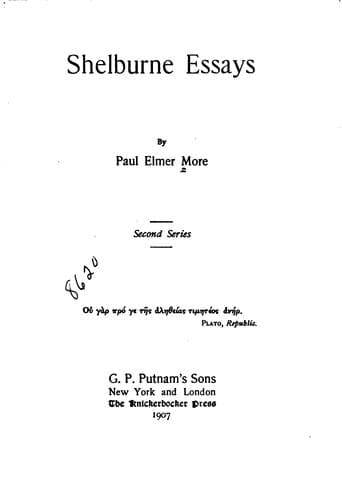
American literature -- History and criticism; English literature -- History and criticism
That which strikes one most in recalling our intercourse with our
cousin at this time is that our conversation did not consist of
commonplaces; we talked for hours on literary subjects, or, if
persons were under discussion, they were such as had a real
interest; the books we were reading were the chief theme. The low
garden was generally the scene of these conversations, and it was
here we read and talked all through the long summer afternoons ...
Nathaniel Hawthorne had a perennial charm,--his influence on our
cousin was permanent,--and we turned from all other books to
Hawthorne's with fresh delight. There is in existence a well-worn
copy of the _Twice-Told Tales_ that was seldom out of our hands.
[It is in the Preface to this book that Hawthorne boasts of being
"the obscurest man of letters in America."]....
Our cousin was at this and all other times very particular about
his dress and appearance; it seemed to us then that he assumed a
certain exaggeration with regard to them; we did not understand
how consistent it all was with his idea of life....
He was not at all fond of walking, and it is doubtful if he cared
for mountain scenery for its own sake. He responded to the moods
of Nature with a sensitiveness that was natural to him, but it was
her quiet aspects which most affected him. He was a native of "the
land where it is always afternoon."
But life was not all play with young Shorthouse. At the age of sixteen
his father took him into the chemical works which had been founded by
the great-grandfather, and, although his father and later his brother
were indulgent to him in many ways, the best of his energies went to
this business until within a few years of his death. There is something
incongruous, as has been remarked, in the manufacture of vitriol and the
writing of mystical novels. In 1857 he married Sarah Scott, whom he had
known for a number of years, and the young couple took a house in
Edgbaston, the suburb of Birmingham in which they had both grown up and
where they continued to live until the end. Mrs. Shorthouse tells of the
disposition of his hours. He went regularly to business at nine, came
home to dinner in the middle of the day, and returned to town till
nearly seven. The evenings, after the first hour of relaxation, were
mostly devoted to studying Greek, reading classics and divinity, and the
seventeenth-century literature, which had always possessed a peculiar
fascination for him. During the years from 1866 to 1876 he was slowly
putting together his story of _John Inglesant_, and with the exception
of his wife, no one saw the writing, or, indeed, knew that he had a work
of any such magnitude on hand. For four years he kept the completed
manuscript, which was rejected by one or two publishers, and then, in
1880, he printed an edition of a hundred copies for private
distribution. One of these fell into the hands of Mrs.
Public-domain text, read in full here on John Shaqi.
Reviews
Reviews
No reviews yet
Be the first to share your thoughts on this work.
Elsewhere in the archive
Join the Discussion
Join the discussion
Sign in to leave a comment or review.
Sign InorCreate an account