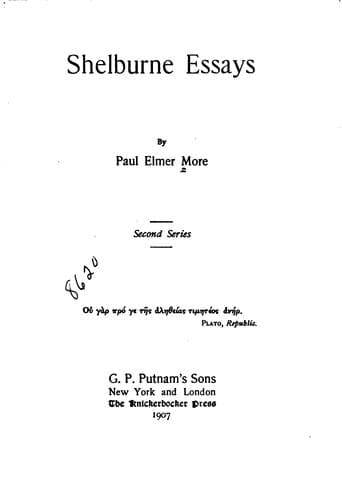
American literature -- History and criticism; English literature -- History and criticism
Nor is his relation to the three-cornered embroglio within the Church
itself anywhere set forth in detail. Almost it would seem as if he dwelt
in some charmed corner of the fold into which the reverberations of
those terrific words _Broad_ and _High_ and _Low_ penetrated only as a
subdued muttering. To supplement this defect I have myself been reading
some of the literature of that contest, and among other things a series
of able papers on _Le Mouvement Ritualiste dans l'Église Anglicane_,
which M. Paul Thureau-Dangin has just published in the _Revue des Deux
Mondes_. The impression left on my own mind has been in the highest
degree contradictory and exasperating. One labours incessantly to know
what all this tumult is about, and I should suppose that no more
inveterate and vicious display of parochialism was ever enacted in this
world. To pass from these disputes to the religious conflict that was
going on in France at the same time is to learn in a striking way the
difference between words and ideas; and even our own pet transcendental
hubbub in Concord is in comparison with the Oxford debate vast and
cosmopolitan in significance. The intrusion of a single idea into that
mad logomachy would have been a phenomenon more appalling than the
appearance of a naked body in a London drawing-room, and it is not
without its amusing side that one of Newman's associates is said to have
dreaded "the preponderance of intellect among the elements of character
and as a guide of life" in that perplexed apologist. Ideas are not
conspicuous anywhere in English literature, least of all in its
religious books, and often one is inclined to extend Bagehot's cynical
pleasantry as a cloak for deficiencies here, too: the stupidity of the
English is the salvation of their literature as well as of their
politics. For it is only fair to add that this ecclesiastical battle, if
paltry in abstract thought, was rich in human character and in a certain
obstinate perception of the validity of traditional forms; it was at
bottom a contest over the position of the Church in the intricate
hierarchy of society, and pure religion was the least important factor
under consideration.
Public-domain text, read in full here on John Shaqi.
Reviews
Reviews
No reviews yet
Be the first to share your thoughts on this work.
Elsewhere in the archive
Join the Discussion
Join the discussion
Sign in to leave a comment or review.
Sign InorCreate an account