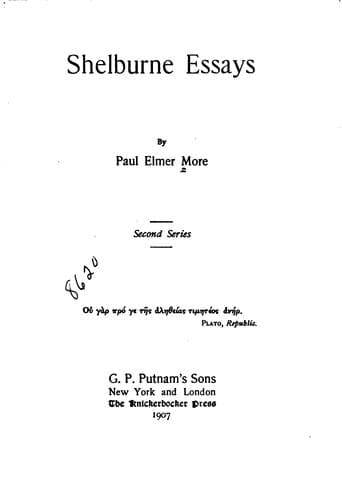
American literature -- History and criticism; English literature -- History and criticism
There is an agreement among philosophers and scientists that the concept
of space is not derived from external experience, but is inherently
intuitive. As stated by Kant:
The representation of space cannot be borrowed through experience
from relations of external phenomena, but, on the contrary, those
external phenomena become possible only by means of the
representation of space. Space is a necessary representation, _a
priori_, forming the very foundation of external intuitions. It is
impossible to imagine that there should be no space, though it is
possible to imagine space without objects to fill it.
The concept of space therefore makes possible the intuition of external
phenomena; but these phenomena to be realised must appeal to one of our
senses, and this connecting link between the outer world and our
consciousness is the concept which we call time. Quoting again from
Kant:
Time is the formal condition, _a priori_, of all phenomena
whatsoever. But, as all representations, whether they have for
their objects external things or not, belong by themselves, as
determinations of the mind, to our inner state;... therefore, if I
am able to say, _a priori_, that all external phenomena are in
space, I can, according to the principle of the internal sense,
make the general assertion that all phenomena, that is, all
objects of the senses, are _in time_, and stand necessarily in
relations of time.
It follows, then, that our simplest possible expression for phenomena
will be in terms of space and time, and that beyond this the human mind
cannot go.
Turning here from metaphysical to scientific language, we speak of space
and time as the fundamental units from which we deduce the laws of the
external world. The fact that space appeals to us only through time
furnishes us with our concept or unit of motion, which is the ratio of
space to time. The external phenomena so revealed to us we call the
manifestations of mass or energy, thus providing ourselves with a second
unit. It must be observed, however, that mass or energy is not a new
concept, but bears precisely the same relation to motion as Kant's
_Ding-an-sich_ bears to space and time: it is the unknowable cause of
motion--or more properly speaking it is the ability residing in an
object to change the motion of another object and is measured by the
degree of change it can produce. And I say mass or energy, advisedly,
for the two are merely different names or different views of the same
thing; we cannot conceive of matter without energy or of energy without
matter. Our choice between the two depends solely on the simplicity and
convenience with which deductions may be made from one or the other.
From a physical standpoint the concept energy is rather the simpler, but
mathematically our deductions flow more readily from the concept mass.
Public-domain text, read in full here on John Shaqi.
Reviews
Reviews
No reviews yet
Be the first to share your thoughts on this work.
Elsewhere in the archive
Join the Discussion
Join the discussion
Sign in to leave a comment or review.
Sign InorCreate an account