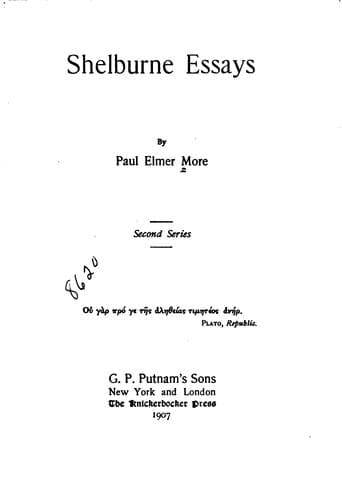
American literature -- History and criticism; English literature -- History and criticism
If then our explanations of phenomena must ultimately involve the two
units of motion and of energy or mass, and if it can be demonstrated
that on this basis we may account for any group of phenomena in an
infinite number of ways, what shall we say but that the attempt to
attain any resting-place for the mind in the laws of nature is, and must
always be, futile? Further than this, any given law is itself only an
approximate explanation of phenomena, and must be continually modified
as we add to our experimental knowledge. In all cases a law must be
considered valid only within the limits of the sensitiveness of the
instruments by which we get our measurements. With more delicate
instruments variations will be observed that must be expressed by
additional terms in the formula. Thus we maintain that the law of
gravitation is true only within the range of our observation; it does
not apply to masses of molecular dimensions. Another formula, the
well-known law of the pressure of gases, can be shown by experiment to
be merely an approximation, because the variations in it are not of a
dimension negligible in comparison with the sensibility of our
instruments. As the pressure increases the error in the formular
equation becomes constantly greater. To remedy this a second
approximation, which is still inadequate, has been added to the equation
by Van der Waals; yet greater accuracy will require the addition of
other terms; and a complete demonstration would demand an infinite
series of approximations.
The meaning of all this is quite plain: there is no reach of the human
intellect which can bridge the gap between motion and rest. Our senses
are adapted to a world of universal flux which is, so far as we can
determine, subject to no absolute law but the law of probabilities. He
who attempts to circumscribe the ebb and flow of circumstance within the
bounds of our spiritual needs, he who attempts to find peace in any
formula of science or in any promise of historic progress, is like one
who labours on the old and vain problem of squaring the circle:
Qual è'l geomètra, che tutto s'affige
Per misurar lo cerchio, e non ritrova,
Pensando, quel principio ond' egli indige.
Public-domain text, read in full here on John Shaqi.
Reviews
Reviews
No reviews yet
Be the first to share your thoughts on this work.
Elsewhere in the archive
Join the Discussion
Join the discussion
Sign in to leave a comment or review.
Sign InorCreate an account