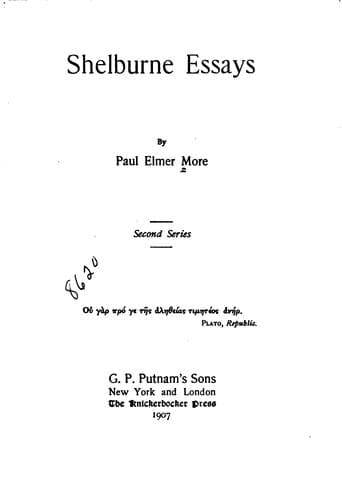
American literature -- History and criticism; English literature -- History and criticism
The desire of peace, as the world has known it in past times, signified
always a turning away from the flotsam and jetsam of time and an attempt
to fix the mind on absolute rest and unity,--the desire of peace has
been the aspiration of faith. And because the object of faith cannot be
seen by the eyes of the body or expressed in terms of the understanding,
a firm grasp of the will has been necessary to keep the desire of the
heart from falling back into the visible, tangible things of change and
motion. For this reason, when the will is relaxed, doubts spring up and
men give themselves wholly to the transient intoxication of the senses.
Yet blessed are they that believe and have not seen. It was the peculiar
quest of the nineteenth century to discover fixed laws and an unshaken
abiding place for the mind in the very kingdom of unrest; we have sought
to chain the waves of the sea with the winds.
And how does all this affect one who stands apart, striving in his own
small way to live in the serene contemplation of the universe? I cannot
doubt that there are some in the world to-day who look back over the
long past and watch the toiling of the human race toward peace as a
traveller in the Alps may with a telescope follow the mountain-climbers
in their slow ascent through the snows of Mont Blanc; or again they
watch our labours and painstaking in the valley of the senses and wonder
at our grotesque industry; or look upon the striving of men to build a
city for the soul amid the uncertainties of this life, as men look at
the play of children who build castles and domes in the sands of the
seashore and cry out when the advancing waves wash all their hopes away.
I think there are some such men in the world to-day who are absorbed in
the fellowship of the wise men of the East, and of the no less wise
Plato, with whom they would retort upon the accusing advocates of the
present: "Do you think that a spirit full of lofty thoughts, and
privileged to contemplate all time and all existence, can possibly
attach any great importance to this life?" They live in the world of
action, but are not of it. They pass each other at rare intervals on the
thoroughfares of life and know each other by a secret sign, and smile to
each other and go on their way comforted and in better hope.
FOOTNOTES:
[1] _The Correspondence of William Cowper._ Arranged in chronological
order, with annotations, by Thomas Wright, Principal of Cowper School,
Olney. Four volumes. New York: Dodd, Mead, & Co., 1904.
[2] In a newly published volume of the letters of William Bodham Donne
(the friend of Edward FitzGerald and Bernard Barton), the editor,
Catharine B. Johnson, throws doubt on this supposed descent of Cowper's
mother from the Poet Dean.
Public-domain text, read in full here on John Shaqi.
Reviews
Reviews
No reviews yet
Be the first to share your thoughts on this work.
Elsewhere in the archive
Join the Discussion
Join the discussion
Sign in to leave a comment or review.
Sign InorCreate an account