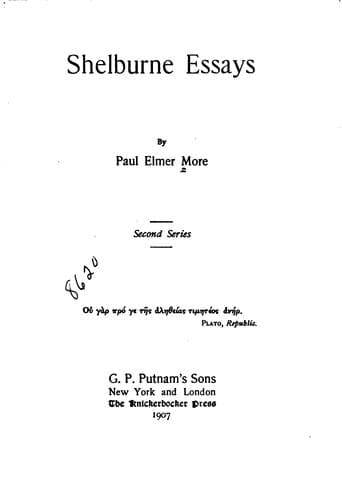
American literature -- History and criticism; English literature -- History and criticism
Yet through all these honours I cannot help observing a strain of
reluctance, as so often happens with a critic who has made himself
feared by the rectitude of his judgments. There has, for one thing, been
a good deal of rather foolish scandal-mongering and raking up of old
anecdotes about his gross habits. Well, Sainte-Beuve was sensual. "Je
suis du peuple ainsi que mes amours," he was wont to hum over his work;
and when that work was finished, his secretary tells us how he used to
draw a hat down over his face (that face _dont le front démesurément
haut rayonne de sérénité froide_), and go out on the street for any
chance liaison. There is something too much of these stories in what is
written of Sainte-Beuve to-day; and in the estimate of his intellectual
career too little emphasis is laid on what was stable in his opinions,
and too much emphasis on the changes of his religious and literary
creed. To be sure, these mutations of belief are commonly cited as his
preparation for the art of critic, and in a certain sense this is right.
But even then, if by critic is meant one who merely decides the value of
this or that book, the essential word is left unsaid. He was a critic,
and something more; he was, if any man may claim such a title, the
_maître universel_ of the century, as, indeed, he has been called.
And the time of his life contributed as much to this position of Doctor
Universalis as did his own intelligence. France, during those years from
the Revolution of 1830 to the fall of the Second Empire, was the
seething-pot of modern ideas, and the impression left by the history of
the period is not unlike that of watching the witch scenes in _Macbeth_.
The eighteenth century had been earnest, mad in part, but its intention
was comparatively single,--to tear down the fabric of authority, whether
political or religious, and allow human nature, which was fundamentally
good, though depraved by custom, to assert itself. And human nature did
assert itself pretty vigorously in the French Revolution, proving, one
might suppose, if it proved anything, that its foundation, like its
origin, is with the beasts. To the men who came afterward that
tremendous event stood like a great prism between themselves and the
preceding age; the pillar of light toward which they looked for guidance
was distorted by it and shattered into a thousand coloured rays. For
many of them, as for Sainte-Beuve, it meant that the old humanitarian
passion remained side by side with a profound distrust of the popular
heart; for all, the path of reform took the direction of some individual
caprice or ideal. There were democrats and monarchists and imperialists;
there was the rigid Catholic reaction led by Bonald and de Maistre, and
the liberal Catholicism of Lamennais; there was the socialism of
Saint-Simon, mixed with notions of a religious hierarchy, and other
schemes of socialism innumerable; while skepticism took every form of
condescension or antagonism.
Public-domain text, read in full here on John Shaqi.
Reviews
Reviews
No reviews yet
Be the first to share your thoughts on this work.
Join the Discussion
Join the discussion
Sign in to leave a comment or review.
Sign InorCreate an account