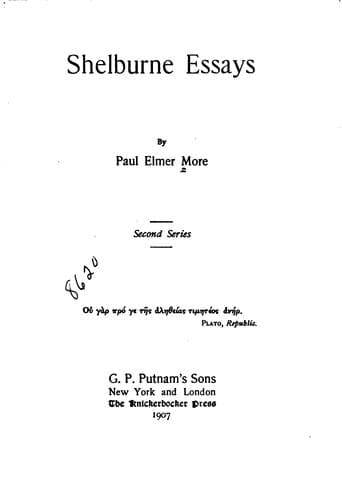
American literature -- History and criticism; English literature -- History and criticism
Yet if Sainte-Beuve is essentially French, indeed almost inconceivable
in English, he is still immensely valuable, perhaps even more valuable,
to us for that very reason. There is nothing more wholesome than to dip
into this strong and steady current of wise judgment. It is good for us
to catch the glow of his masterful knowledge of letters and his faith in
their supreme interest. His long row of volumes are the scholar's Summa
Theologiæ. As John Cotton loved to sweeten his mouth with a piece of
Calvin before he went to sleep, so the scholar may turn to Sainte-Beuve,
sure of his never-failing abundance and his ripe intelligence.
THE SCOTCH NOVELS AND SCOTCH HISTORY
Like many another innocent, no doubt, I was seduced not long ago by the
potent spell of Mr. Andrew Lang's name into reading his voluminous
_History of Scotland_. Being too, like Mr. Lang, sealed of the tribe of
Sir Walter, and knowing in a general way some of the romantic features
of Scotch annals, I was led to suppose that these bulky volumes would be
crammed from cover to cover with the pageantry of fair Romance. Alas, I
soon learned, as I have so often learned before, that a little knowledge
is a dangerous thing; and I was taught, moreover, a new application of
several well-worn lines of Milton. Amid the inextricable feuds of
Britons, Scots, Picts, and English; amid the incomprehensible medley of
Bruces, Balliols, Stuarts, Douglases, Plantagenets, and Tudors; amid the
horrid tumult of Roberts, Davids, Jameses, Malcolms (may their tribes
decrease!), Mr. Lang's reader, if he be of alien blood and foreign
shores, wanders helpless and utterly bewildered. On leaving that _selva
oscura_ I felt not unlike Milton's courageous hero (in courage only, I
trust) before the realm of Chaos and eldest Night, where naught was
perceptible but eternal anarchy and noise of endless wars. Yet with
this bold adventurer it might be said by me:
I come no spy,
With purpose to explore or to disturb
The secrets of your realm; but by constraint
Wandering this darksome desert, as my way
Led through your spacious empire up to light.
For throughout the labyrinth of all this anfractuous narrative
there was indeed one guiding ray of light. As often as the author
by way of anecdote or allusion--and happily this occurred pretty
frequently--mentioned the works of Scott, a new and powerful interest
was given to the page. The very name of Scott seemed providentially
symbolical of his office in literature, and through him Scots history
has become a theme of significance to all the world.
Public-domain text, read in full here on John Shaqi.
Reviews
Reviews
No reviews yet
Be the first to share your thoughts on this work.
Join the Discussion
Join the discussion
Sign in to leave a comment or review.
Sign InorCreate an account