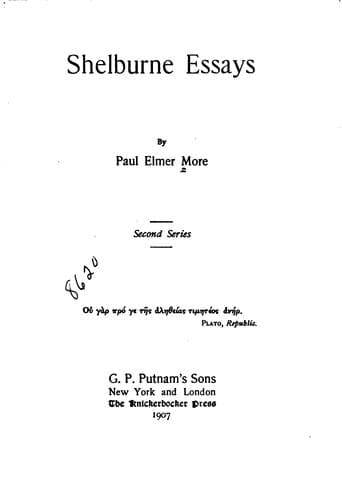
American literature -- History and criticism; English literature -- History and criticism
But even here the reverberation of the words begins to conceal their
meaning, and such abstractions as "the roar of the hours" lead into the
worst of Swinburne's faults. Many of the longer hymns to liberty are
nearly unreadable--at least if any one can endure to the end of _A Song
of Italy_, it is not I. And as one goes through these rhapsodies that
came out year after year, one begins to feel that Swinburne's notion of
liberty, when it is not empty of meaning, is something even worse. Too
often it is Kipling's gross idolatry of England uttered in a kind of
hysterical falsetto. It was not pretty at a time of estrangement between
England and France to speak of "French hounds whose necks are aching
Still from the chain they crave"; and one needed not to sympathise with
the Boers in the South African war to feel something like disgust at
Swinburne's abuse:
....... the truth whose witness now draws near
To scourge these dogs, agape with jaws afoam,
Down out of life.
Probably the poet thought he was giving voice to a righteous and
Miltonic indignation. The best criticism of such a sonnet is to turn to
Milton's "Avenge, O Lord, thy slaughtered saints."
I have read somewhere a story of Swinburne's driving up late to a dinner
and entering into a violent altercation with the cabman, to the vast
amusement of the waiting guests within the house. That incorrigible wag
and hanger-on of genius, Charles Augustus Howell, was of the party and
acted as chorus to the dialogue outside. "The poet's got the best of
it, as usual," drawls the chorus. "He lives at the British Hotel in
Cockspur Street, and never goes anywhere except in hansoms, which,
whatever the distance, he invariably remunerates with one shilling.
Consequently, when, as to-day, it's a case of two miles beyond the
radius, there's the devil's own row; but in the matter of imprecation
the poet is more than a match for cabby, who, after five minutes of it,
gallops off as though he had been rated by Beelzebub himself." Really,
'tis a bit of gossip which may be taken as a comment on not a few of
Swinburne's dithyrambs of liberty.
Not less noble in significance is that other word, the sea, which
Swinburne now uses with endless reiteration. In his reverence for the
weltering ocean ways, the bulwark of England's freedom, he does of
course only follow the best traditions of English poetry from _Beowulf_
to _The Seven Seas_ of Kipling, who is again in this his imitator. Nor
is it the world of water alone that dominates his imagination, but with
it the winds and the panorama of the sky ever rolling above. Already in
the _Poems and Ballads_ there is a hint of the sympathy between the poet
and this realm of water and air. One of the finest passages in _The
Triumph of Time_ is that which begins:
I will go back to the great sweet mother,
Mother and lover of men, the sea.
I will go down to her, I and none other,
Close with her, kiss her and mix her with me.
Public-domain text, read in full here on John Shaqi.
Reviews
Reviews
No reviews yet
Be the first to share your thoughts on this work.
Join the Discussion
Join the discussion
Sign in to leave a comment or review.
Sign InorCreate an account