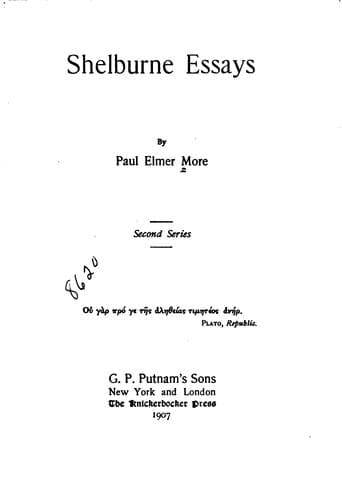
American literature -- History and criticism; English literature -- History and criticism
Writing to his mentor, John Newton (who had left Olney), he declares
that there is a mystery in his destruction; and again to Lady Hesketh:
"Mine has been a life of wonders for many years, and a life of wonders I
in my heart believe it will be to the end." More than once in reply to
those who would console him he avers that there is a singularity in his
case which marks it off from that of all other men, that Providence has
chosen him as a special object of its hostility. In Rousseau, whose
mission was to preach the essential goodness of mankind, the union of
aggravated egotism with his humanitarian doctrine brought about the
conviction that the whole human race was plotting his ruin. In Cowper,
whose mind dwelt on the power and mercies of Providence, this
self-consciousness united with his Calvinism to produce the belief that
God had determined to ensnare and destroy his soul. Such was the strange
twist that accompanied the birth of romanticism in France and in
England.
The conviction came upon Cowper through the agency of dreams and
imaginary voices. The depression first seized him on the 24th of
January, 1773. About a month later a vision of the night troubled his
sleep, so distinct and terrible that the effect on his brain could never
be wholly dispelled. Years afterwards he wrote to a friend:
My thoughts are clad in a sober livery, for the most part as grave
as that of a bishop's servants. They turn upon spiritual subjects;
but the tallest fellow and the loudest among them all is he who
is continually crying with a loud voice, _Actum est de te;
periisti!_ You wish for more attention, I for less. Dissipation
[distraction] itself would be welcome to me, so it were not a
vicious one; but however earnestly invited, is coy, and keeps at a
distance. Yet with all this distressing gloom upon my mind, I
experience, as you do, the slipperiness of the present hour, and
the rapidity with which time escapes me. Every thing around us,
and every thing that befalls us, constitutes a variety, which,
whether agreeable or otherwise, has still a thievish propensity,
and steals from us days, months, and years, with such unparalleled
address, that even while we say they are here, they are gone.
That apparently was the sentence which sounded his doom on the night of
dreams: _Actum est de te; periisti_--it is done with thee, thou hast
perished! and no domestic happiness, or worldly success, or wise counsel
could ever, save for a little while, lull him to forgetfulness. He might
have said to his friends, as Socrates replied to one who came to offer
him deliverance from jail: "Such words I seem to hear, as the mystic
worshippers seem to hear the piping of flutes; and the sound of this
voice so murmurs in my ears that I can hear no other."
Public-domain text, read in full here on John Shaqi.
Reviews
Reviews
No reviews yet
Be the first to share your thoughts on this work.
Join the Discussion
Join the discussion
Sign in to leave a comment or review.
Sign InorCreate an account