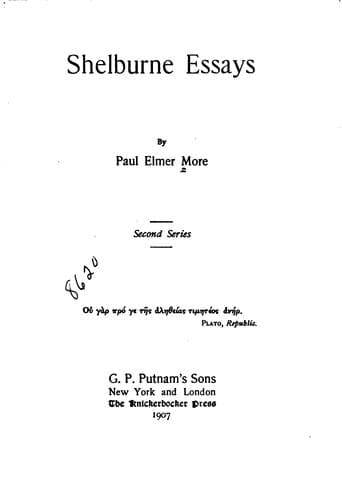
American literature -- History and criticism; English literature -- History and criticism
message, Calderon who expressed the doctrine of the saints and the
poets:
Pues el delito mayor
Del hombre es haber nacido--
(since the greatest transgression of man is to have been born). It was
believed that the spiritual life was bought with a price, and that the
desires of this world must first suffer permutation into something not
themselves. I am not holding a brief for that austere doctrine; I am not
even sure that I quite understand it, although it is written at large in
many books. But I do know that those who think they have found its
equivalent in the poetry of Browning are misled by wandering and futile
lights. The secret of his more esoteric fame is just this, that he
dresses a worldly and easy philosophy in the forms of spiritual faith
and so deceives the troubled seekers after the higher life.
It is not pleasant to be convicted of throwing stones at the prophets,
as I shall appear to many to have done. My only consolation is that, if
the prophet is a true teacher, these stones of the casual passer-by
merely raise a more conspicuous monument to his honour; but if he turns
out in the end to be a false prophet (as I believe Browning to have
been)--why, then, let his disciples look to it.
A NOTE ON BYRON'S "DON JUAN"
It has often been a source of wonder to me that I was able to read and
enjoy Byron's _Don Juan_ under the peculiar circumstances attending my
introduction to that poem. I had been walking in the Alps, and after a
day of unusual exertion found myself in the village of Chamouni,
fatigued and craving rest. A copy of the Tauchnitz edition fell into my
hands, and there, in a little room, through a summer's day, by a window
which looked full upon the unshadowed splendour of Mont Blanc, I sat and
read, and only arose when Juan faded out of sight with "the phantom of
her frolic Grace--Fitz-Fulke." I have often wondered, I say, why the
incongruity of that solemn Alpine scene with the mockery of Byron's wit
did not cause me to shut the book and thrust it away, for in general I
am highly sensitive to the nature of my surroundings while reading. Only
recently, on taking up the poem again for the purpose of editing it, did
the answer to that riddle occur to me, and with it a better
understanding of the place of _Don Juan_ among the great epics which
might have seemed in finer accord with the sublimity and peace of that
memorable day.
Public-domain text, read in full here on John Shaqi.
Reviews
Reviews
No reviews yet
Be the first to share your thoughts on this work.
Elsewhere in the archive
Join the Discussion
Join the discussion
Sign in to leave a comment or review.
Sign InorCreate an account