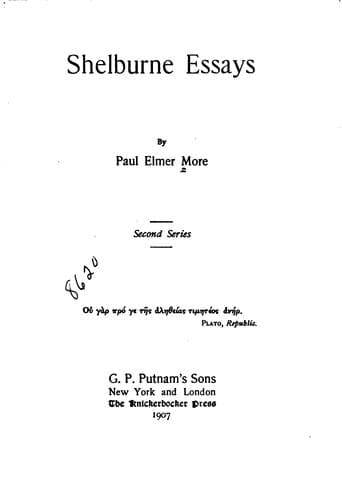
American literature -- History and criticism; English literature -- History and criticism
In one respect, at least, it needed no return to Byron's work to show
how closely it is related in spirit to the accepted canons of the past.
These poets, who have filled the world with their rumour, all looked
upon life with some curious obliquity of vision. We, who have approached
the consummation of the world's hope, know that happiness and peace and
the fulfilment of desires are about to settle down and brood for ever
more over the lot of mankind, but with them it seems to have been
otherwise. Who can forget the recurring _minynthadion_ of Homer, in
which he summed up for the men of his day the vanity of long
aspirations? So if we were asked to point out the lines of Shakespeare
that express most completely his attitude toward life, we should
probably quote that soliloquy of Hamlet wherein he catalogues the evils
of existence, and only in the fear of future dreams finds a reason for
continuance; or we should cite that sonnet of disillusion: "Tired with
all these for restful death I cry." And as for the lyric poets, sooner
or later the lament of Shelley was wrung from the lips of each:
Out of the day and night
A joy has taken flight:
Fresh spring, and summer, and winter hoar
Move my faint heart with grief, but with delight
No more--oh, never more!
This, I repeat, is a strange fact, for it appears that these poets,
prophets who spoke in the language of beauty and who have held the
world's reverence so long--it appears now that these interpreters of the
fates were all misled. Possibly, as Aristotle intimated, genius is
allied to some vice of the secretions which produces a melancholia of
the brain; something like this, indeed, only expressed in more recondite
terms, may be found in the most modern theory of science. But more
probably they wrote merely from insufficient experience, not having
perceived how the human race with increase of knowledge grows in
happiness. Thus, at least, it seems to one who observes the tides of
thought. Next year, or the next, some divine invention shall come which
will prove this melancholy of the poets to have been only a childish
ignorance of man's sublimer destiny; some discovery of a new element
more wonderful than radium will render the ancient brooding over human
feebleness a matter of laughter and astonishment; some acceptance of the
larger brotherhood of the race will wipe away all tears and bring down
upon earth the fair dream of heaven, a reality and a possession for
ever; some new philosophy of the soul will convert the old poems of
conflict into meaningless fables, stale and unprofitable. Already we see
the change at hand. To how many persons to-day does Browning
appeal--though they would not always confess it--more powerfully than
Homer or Milton or any other of the great names of antiquity? And the
reason of this closer appeal of Browning is chiefly the unflagging
optimism of his philosophy, his full-blooded knowledge and sympathy
Public-domain text, read in full here on John Shaqi.
Reviews
Reviews
No reviews yet
Be the first to share your thoughts on this work.
Elsewhere in the archive
Join the Discussion
Join the discussion
Sign in to leave a comment or review.
Sign InorCreate an account