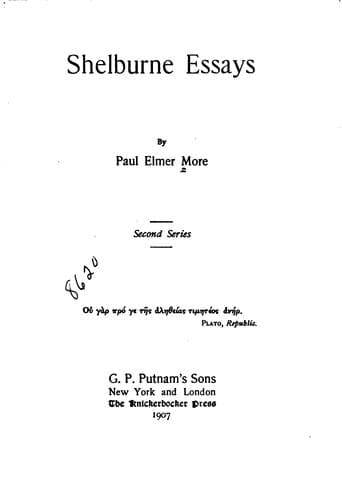
American literature -- History and criticism; English literature -- History and criticism
which make the wailings of the past somewhat silly in our ears, if truth
must be told. I never read Browning but those extraordinary lines of
Euripides recur to my mind: "Not now for the first time do I regard
mortal things as a shadow, nor would I fear to charge with supreme folly
those artificers of words who are reckoned the sages of mankind, for no
man among mortals is happy." [Greek: Thnêtôn gar oudeis estin eudaimôn],
indeed!--would any one be shameless enough to utter such words under the
new dispensation of official optimism?
It is necessary to think of these things before we attempt to criticise
Byron, for _Don Juan_, too, despite its marvellous vivacity, looks upon
life from the old point of view. Already, for this reason in part, it
seems a little antiquated to us, and in a few years it may be read only
as a curiosity. Meanwhile for the few who lag behind in the urgent march
of progress the poem will possess a special interest just because it
presents the ancient thesis of the poets and prophets in a novel form.
Of course, in many lesser matters it makes a wider and more lasting
appeal. Part of the Haidée episode, for instance, is so exquisitely
lovely, so radiant with the golden haze of youth, that even in the wiser
happiness of our maturity we may still turn to it with a kind of
complacent delight. Briefer passages scattered here and there, such as
the "'T is sweet to hear," and the "Ave Maria," need only a little
abridgment at the close to fit them perfectly for any future anthology
devoted to the satisfaction and the ultimate significance of human
emotions. But, strangely enough, these disturbing climaxes, which will
demand to be forgotten, or to be rearranged as we restore old mutilated
statues, do, indeed, point to those very qualities which render the poem
so extraordinary a complement to the great and accepted epics of the
past. For the present it may yet be sufficient to consider _Don Juan_ as
it is--with all its enormities upon it.
Public-domain text, read in full here on John Shaqi.
Reviews
Reviews
No reviews yet
Be the first to share your thoughts on this work.
Elsewhere in the archive
Join the Discussion
Join the discussion
Sign in to leave a comment or review.
Sign InorCreate an account