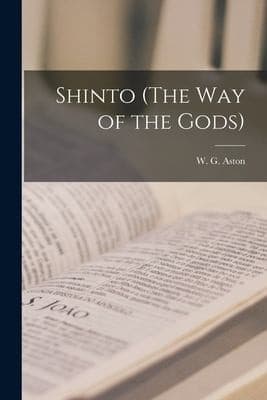
Shinto (the Way of the Gods)Aston, W. G. (William George)
Religion
Shinto (the Way of the Gods)
Aston, W. G. (William George)
Shinto
This is the great sword Kusanagi (Herb-queller)."_
On the occasion of his marriage to Kushinada hime, Susa no wo composed
the following verses:--
_Many clouds arise,_
_On all sides a manifold fence:_
_To receive within it the spouses,_
_They form a manifold fence,_
_Ah! that manifold fence!_
Eventually he entered the Nether Land.
Few of my readers will require to have pointed out to them the striking
resemblance of this story to that of Perseus and Andromeda, or will
need to be referred to Mr. Sidney Hartland's 'Legend of Perseus,'
in which everything relating to its numerous variants has been so
thoroughly examined. I would direct special attention to chapter
xviii. of this work, where the hypothesis is offered, "that we have
in this incident a reminiscence of the abolition of human sacrifices
to deities in the shape of the lower animals.... In certain stages of
civilization, sacrifices of the kind are practised, and are frequently
offered to water-spirits conceived in animal form.... It may, of
course, be that the monster sent to devour Andromeda is to be regarded
simply as the personification of water, or of specific rivers in their
sinister aspect."[78]
The circumstance that the scene of this episode in Susa no wo's career
is the bank of a river is therefore by no means immaterial. Indeed,
we may plausibly conjecture that the description of the serpent with
its eight (or many) heads and eight tails, its length extending over
eight valleys and eight hills, its body overgrown with moss, pines,
and cedars, and its propensity for devouring human beings is nothing
more than a fanciful representation of the river, with its serpentine
course, its numerous tributaries and branches, its wooded banks, and
the danger by drowning in its pools or at its fords.
The poem ascribed to Susa no wo cannot be older than the sixth or
seventh century. The word translated "on all sides," is _idzumo_. There
is therefore a punning allusion to the province of that name. The
"manifold fence," is the "nuptial hut," already referred to.[79]
=Ohonamochi=.--Susa no wo had numerous children, among whom were
Oho-toshi (great harvest), and Uka no mitama[80] (food-spirit). The
most famous of his progeny was a God called Ohonamochi. This is the
Great Deity of Idzumo, a place second only to Ise for sanctity.
Public-domain text, read in full here on John Shaqi.
Reviews
Reviews
No reviews yet
Be the first to share your thoughts on this work.
Elsewhere in the archive
Join the Discussion
Join the discussion
Sign in to leave a comment or review.
Sign InorCreate an account