Produced by David Starner, William Fishburne and the Online
Distributed Proofreading Team.
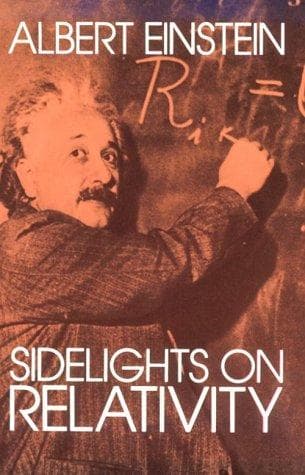
SIDELIGHTS ON RELATIVITY
By Albert Einstein
Contents
ETHER AND THE THEORY OF RELATIVITY
An Address delivered on May 5th, 1920, in the University of Leyden
GEOMETRY AND EXPERIENCE
An expanded form of an Address to the Prussian Academy of Sciences
in Berlin on January 27th, 1921.
ETHER AND THE THEORY OF RELATIVITY
An Address delivered on May 5th, 1920, in the University of Leyden
How does it come about that alongside of the idea of ponderable
matter, which is derived by abstraction from everyday life, the
physicists set the idea of the existence of another kind of matter,
the ether? The explanation is probably to be sought in those phenomena
which have given rise to the theory of action at a distance, and
in the properties of light which have led to the undulatory theory.
Let us devote a little while to the consideration of these two
subjects.
Outside of physics we know nothing of action at a distance. When
we try to connect cause and effect in the experiences which natural
objects afford us, it seems at first as if there were no other mutual
actions than those of immediate contact, e.g. the communication of
motion by impact, push and pull, heating or inducing combustion by
means of a flame, etc. It is true that even in everyday experience
weight, which is in a sense action at a distance, plays a very
important part. But since in daily experience the weight of bodies
meets us as something constant, something not linked to any cause
which is variable in time or place, we do not in everyday life
speculate as to the cause of gravity, and therefore do not become
conscious of its character as action at a distance. It was Newton's
theory of gravitation that first assigned a cause for gravity by
interpreting it as action at a distance, proceeding from masses.
Newton's theory is probably the greatest stride ever made in
the effort towards the causal nexus of natural phenomena. And yet
this theory evoked a lively sense of discomfort among Newton's
contemporaries, because it seemed to be in conflict with the
principle springing from the rest of experience, that there can be
reciprocal action only through contact, and not through immediate
action at a distance. It is only with reluctance that man's desire
for knowledge endures a dualism of this kind. How was unity to
be preserved in his comprehension of the forces of nature? Either
by trying to look upon contact forces as being themselves distant
forces which admittedly are observable only at a very small
distance--and this was the road which Newton's followers, who were
entirely under the spell of his doctrine, mostly preferred to
take; or by assuming that the Newtonian action at a distance is
only _apparently_ immediate action at a distance, but in truth is
conveyed by a medium permeating space, whether by movements or by
elastic deformation of this medium. Thus the endeavour toward a
Public-domain text, read in full here on John Shaqi.
Reviews
Reviews
No reviews yet
Be the first to share your thoughts on this work.
Join the Discussion
Join the discussion
Sign in to leave a comment or review.
Sign InorCreate an account