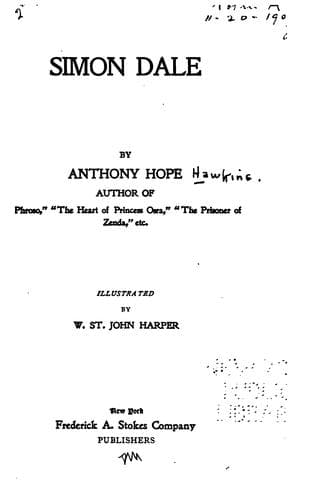
Great Britain -- History -- Charles II, 1660-1685 -- Fiction
peace, but the stir of the blood, the work of the hand, and the service
of the brain make a life that a man can look back on without shame and
with delight.
I was nearing my twenty-second birthday when I returned to Hatchstead
with an air and manner, I doubt not, sadly provincial, but with a lining
to my pocket for whose sake many a gallant would have surrendered some
of his plumes and feathers. Three thousand pounds, invested in my
uncle's business and returning good and punctual profit made of Simon
Dale a person of far greater importance in the eyes of his family than
he had been three years ago. It was a competence on which a gentleman
could live with discretion and modesty, it was a step from which his
foot could rise higher on life's ladder. London was in my power, all it
held of promise and possibility was not beyond the flight of my soaring
mind. My sisters exchanged sharp admonitions for admiring deference, and
my mother feared nothing save that the great place to which I was now
surely destined might impair the homely virtues which she had instilled
into me. As for the Vicar, he stroked his nose and glanced at me with
an eye which spoke so plainly of Betty Nasroth that I fell to laughing
heartily.
Thus, being in great danger of self-exaltation, I took the best medicine
that I could--although by no means with intention--in waiting on my lord
Quinton, who was then residing at the Manor. Here my swelled spirit was
smartly pricked, and sank soon to its true proportions. I was no great
man here, and although my lord received me very kindly, he had less to
say on the richness of my fortune than on the faults of my manner and
the rustic air of my attire. Yet he bade me go to London, since there a
man, rubbing shoulders with all the world, learnt to appraise his own
value, and lost the ignorant conceit of himself that a village greatness
is apt to breed. Somewhat crestfallen, I thanked him for his kindness,
and made bold to ask after Mistress Barbara.
"She is well enough," he answered, smiling. "And she is become a great
lady. The wits make epigrams on her, and the fools address verses to
her. But she's a good girl, Simon."
"I'm sure of it, my lord," I cried.
"He's a bold man who would be sure of it concerning anyone nowadays," he
said dryly. "Yet so, thank God, it is. See, here's a copy of the verses
she had lately," and he flung me the paper. I glanced over it and saw
much about "dazzling ice," "unmelting snow," "Venus," "Diana," and so
forth.
"It seems sad stuff, my lord," said I.
"Why, yes," he laughed; "but it is by a gentle man of repute. Take care
you write none worse, Simon."
"Shall I have the honour of waiting on Mistress Barbara, my lord?" I
asked.
"As to that, Simon, we will see when you come. Yes, we must see what
company you keep. For example, on whom else do you think of waiting when
you are set up in London?"
Public-domain text, read in full here on John Shaqi.
Reviews
Reviews
No reviews yet
Be the first to share your thoughts on this work.
Join the Discussion
Join the discussion
Sign in to leave a comment or review.
Sign InorCreate an account