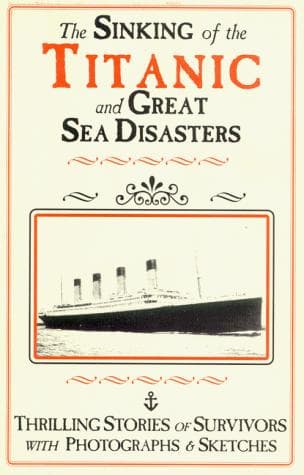
Shipwrecks -- North Atlantic Ocean; Titanic (Steamship)
Portugal was the first nation to engage in voyages of discovery, using
vessels of small size in these adventurous journeys. Spain, which soon
became her rival in this field, built larger ships and long held the
lead. Yet the ships with which Columbus made the discovery of America
were of a size and character in which few sailors of the present day
would care to venture far from land.
England was later in coming into the field of adventurous navigation,
being surpassed not only by the Portuguese and Spanish, but by the
Dutch, in ventures to far lands.
Europe long held the precedence in shipbuilding and enterprise in
navigation, but the shores of America had not long been settled before
the venturous colonists had ships upon the seas. The first of these was
built at the mouth of the Kennebec River in Maine. This was a staunch
little two-masted vessel, which was named the Virginia, supposed to have
been about sixty feet long and seventeen feet in beam. Next in time came
the Restless, built in 1614 or 1615 at New York, by Adrian Blok, a Dutch
captain whose ships had been burned while lying at Manhattan Island.
This vessel, thirty-eight feet long and of eleven feet beam, was
employed for several years in exploring the Atlantic coast.
With the advent of the nineteenth century a new ideal in naval
architecture arose, that of the ship moved by steam-power instead of
wind-power, and fitted to combat with the seas alike in storm and calm,
with little heed as to whether the wind was fair or foul. The steamship
appeared, and grew in size and power until such giants of the wave as
the Titanic and Olympic were set afloat. To the development of this
modern class of ships our attention must now be turned.
As the reckless cowboy of the West is fast becoming a thing of the past,
so is the daring seaman of fame and story. In his place is coming a
class of men miscalled sailors, who never reefed a sail or coiled a
cable, who do not know how to launch a life-boat or pull an oar, and
in whose career we meet the ridiculous episode of the life-boats of the
Titanic, where women were obliged to take the oars from their hands and
row the boats. Thus has the old-time hero of the waves been transformed
into one fitted to serve as a clown of the vaudeville stage.
Public-domain text, read in full here on John Shaqi.
Reviews
Reviews
No reviews yet
Be the first to share your thoughts on this work.
Elsewhere in the archive
Join the Discussion
Join the discussion
Sign in to leave a comment or review.
Sign InorCreate an account