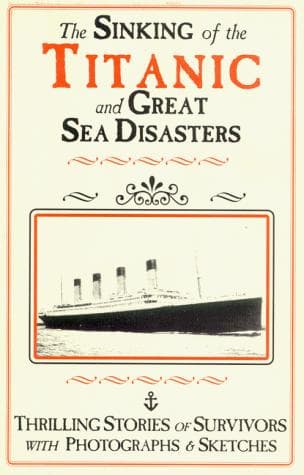
Shipwrecks -- North Atlantic Ocean; Titanic (Steamship)
The advent of steam navigation came early in the nineteenth century,
though interesting steps in this direction were taken earlier. No sooner
was the steam-engine developed than men began to speculate on it as a
moving power on sea and land. Early among these were several Americans,
Oliver Evans, one of the first to project steam railway travel, and
James Rumsey and John Fitch, steamboat inventors of early date. There
were several experimenters in Europe also, but the first to produce a
practical steamboat was Robert Fulton, a native of Pennsylvania, whose
successful boat; the Clermont, made its maiden trip up the Hudson in
1807. A crude affair was the Clermont, with a top speed of about seven
miles an hour; but it was the dwarf from which the giant steamers of
to-day have grown.
Boats of this type quickly made their way over the American rivers and
before 1820 regular lines of steamboats were running between England and
Ireland. In 1817 James Watt, the inventor of the practical steam-engine,
crossed in a steamer from England to Belgium. But these short voyages
were far surpassed by an American enterprise, that of the first ocean
steamship, the Savannah, which crossed the Atlantic from Savannah to
Liverpool in 1819.
Twelve years passed before this enterprise was repeated, the next steam
voyage being in 1831, when the Royal William crossed from Quebec to
England. She used coal for fuel, having utilized her entire hold to
store enough for the voyage. The Savannah had burned pitch-pine under
her engines, for in America wood was long used as fuel for steam-making
purposes. As regards this matter, the problem of fuel was of leading
importance, and it was seriously questioned if a ship could be built to
cross the Atlantic depending solely upon steam power. Steam-engines in
those days were not very economical, needing four or five times as much
fuel for the same power as the engines of recent date.
It was not until 1838 that the problem was solved. On April 23d of that
year a most significant event took place. Two steamships dropped anchor
in the harbor of New York, the Sirius and the Great Western. Both of
these had made the entire voyage under steam, the Sirius, in eighteen
and a half and the Great Western in fourteen and a half days, measuring
from Queenstown. The Sirius had taken on board 450 tons of coal, but all
this was burned by the time Sandy Hook was reached, and she had to burn
her spare spars and forty-three barrels of rosin to make her way up the
bay. The Great Western, on the contrary, had coal to spare.
Public-domain text, read in full here on John Shaqi.
Reviews
Reviews
No reviews yet
Be the first to share your thoughts on this work.
Elsewhere in the archive
Join the Discussion
Join the discussion
Sign in to leave a comment or review.
Sign InorCreate an account