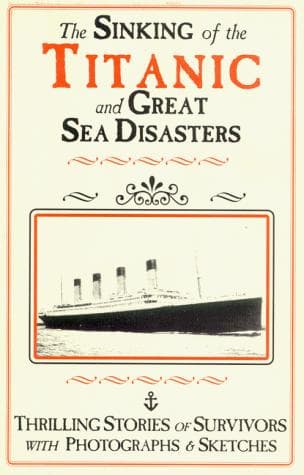
Shipwrecks -- North Atlantic Ocean; Titanic (Steamship)
Other ocean steamship companies gradually arose, some of which are still
in existence. But no especial change in ship-building was introduced
until 1870, when the Oceanic Company, now known as the White Star Line,
built the Britannic and Germanic. These were the largest of its early
ships. They were 468 feet long and 35 feet wide, constituting a new type
of extreme length as compared with their width. In the first White Star
ship, the Oceanic, the improvements above mentioned were introduced, the
saloons and staterooms being brought as near as possible to the center
of the ship. All the principal lines built since that date have followed
this example, thus adding much to the comfort of the first-class
passengers.
Speed and economy in power also became features of importance, the
tubular boiler and the compound engine being introduced. These have
developed into the cylindrical, multitubular boiler and the triple
expansion engine, in which a greater percentage of the power of the
steam is utilized and four or five times the work obtained from coal
over that of the old system. The side-wheel was continued in use in the
older ships until this period, but after 1870 it disappeared.
It has been said that the life of iron ships, barring disasters at sea,
is unlimited, that they cannot wear out. This statement has not been
tested, but the fact remains that the older passenger ships have gone
out of service and that steel has now taken the place of iron, as
lighter and more durable.
Something should also be said here of the steam turbine engine, recently
introduced in some of the greatest liners, and of proven value in
several particulars, an important one of these being the doing away with
the vibration, an inseparable accompaniment of the old style engines.
The Olympic and Titanic engines were a combination of the turbine and
reciprocating types. In regard to the driving power, one of the recent
introductions is that of the multiple propeller. The twin screw was
first applied in the City of New York, of the Inman line, and enabled
her to make in 1890 an average speed of a little over six days from New
York to Queenstown. The best record up to October, 1891, was that of the
Teutonic, of five days, sixteen hours, and thirty minutes. Triple-screw
propellers have since then been introduced in some of the greater ships,
and the record speed has been cut down to the four days and ten hours of
the Lusitania in 1908 and the four days, six hours and forty-one minutes
of the Mauretania in 1910.
The Titanic was not built especially for speed, but in every other way
she was the master product of the shipbuilders' art. Progress through
the centuries has been steady, and perhaps the twentieth century will
prepare a vessel that will be unsinkable as well as magnificent. Until
the fatal accident the Titanic and Olympic were considered the last
words on ship-building; but much may still remain to be spoken.
CHAPTER XXVII. SAFETY AND LIFE-SAVING DEVICES
Public-domain text, read in full here on John Shaqi.
Reviews
Reviews
No reviews yet
Be the first to share your thoughts on this work.
Elsewhere in the archive
Join the Discussion
Join the discussion
Sign in to leave a comment or review.
Sign InorCreate an account