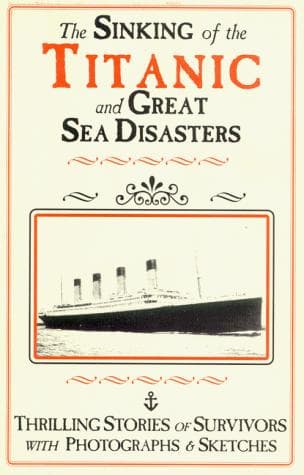
Shipwrecks -- North Atlantic Ocean; Titanic (Steamship)
Two innovations in shipbuilding were soon introduced. These were the
building of iron instead of wooden ships and the replacing of the paddle
wheel by the screw propeller. The screw-propeller was first successfully
introduced by the famous Swede, John Ericsson, in 1835. His propeller
was tried in a small vessel, forty-five feet long and eight wide, which
was driven at the rate of ten miles an hour, and towed a large packet
ship at fair speed. Ericsson, not being appreciated in England, came
to America to experiment. Other inventors were also at work in the same
line.
Their experiments attracted the attention of Isambard Brunel, one of
the greatest engineers of the period, who was then engaged in building
a large paddle-wheel steamer, the Great Britain. Appreciating the new
idea, he had the engines of the new ship changed and a screw propeller
introduced. This ship, a great one for the time, 322 feet long and of
3443 tons, made her first voyage from Liverpool to New York in 1845, her
average speed being 12 1/4 knots an hour, the length of the voyage 14
days and 21 hours.
By the date named the crossing of the Atlantic by steamships had become
a common event. In 1840 the British and Royal Mail Steam Packet Company
was organized, its chief promoter being Samuel Cunard, of Halifax, Nova
Scotia, whose name has long been attached to this famous line.
The first fleet of the Cunard Line comprised four vessels, the
Britannia, Acadia, Caledonia and Columbia. The Unicorn, sent out by this
company as a pioneer, entered Boston harbor on June 2, 1840, being the
first steamship from Europe to reach that port. Regular trips began with
the Britannia, which left Liverpool on July 4, 1840. For a number of
years later this line enjoyed a practical monopoly of the steam carrying
trade between England and the United States. Then other companies came
into the field, chief among them being the Collins Line, started in
1849, and of short duration, and the Inman Line, instituted in 1850.
We should say something here of the comforts and conveniences provided
for the passengers on these early lines. They differed strikingly
from those on the leviathans of recent travel and were little, if any,
superior to those on the packet ships, the active rivals at that date
of the steamers. Then there were none of the comfortable smoking rooms,
well-filled libraries, drawing rooms, electric lights, and other modern
improvements. The saloons and staterooms were in the extreme after part
of the vessel, but the stateroom of that day was little more than a
closet, with two berths, one above the other, and very little standing
room between these and the wall. By paying nearly double fare a
passenger might secure a room for himself, but the room given him
did not compare well even with that of small and unpretentious modern
steamers.
Public-domain text, read in full here on John Shaqi.
Reviews
Reviews
No reviews yet
Be the first to share your thoughts on this work.
Elsewhere in the archive
Join the Discussion
Join the discussion
Sign in to leave a comment or review.
Sign InorCreate an account