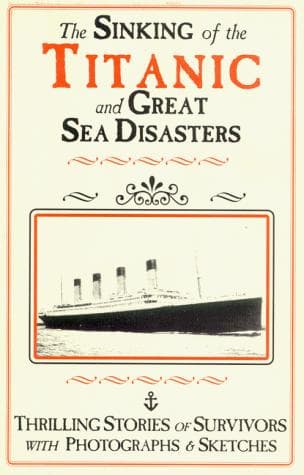
Sinking of the Titanic and Great Sea Disasters — John Shaqi
Sinking of the Titanic and Great Sea Disasters
History
Sinking of the Titanic and Great Sea Disasters
Shipwrecks -- North Atlantic Ocean; Titanic (Steamship)
But there is more than this harvest of debts, and lessons, and sorrows,
in the tragedy of the sinking of the Titanic. There is a great ideal.
It is clearly outlined and set before the mind and heart of the modern
world, to approve and follow, or to despise and reject.
It is, "Women and children first!"
Whatever happened on that dreadful April night among the arctic ice,
certainly that was the order given by the brave and steadfast captain;
certainly that was the law obeyed by the men on the doomed ship. But
why? There is no statute or enactment of any nation to enforce such an
order. There is no trace of such a rule to be found in the history of
ancient civilizations. There is no authority for it among the heathen
races to-day. On a Chinese ship, if we may believe the report of an
official representative, the rule would have been "Men First, children
next, and women last."
There is certainly no argument against this barbaric rule on physical or
material grounds. On the average, a man is stronger than a woman, he is
worth more than a woman, he has a longer prospect of life than a woman.
There is no reason in all the range of physical and economic science,
no reason in all the philosophy of the Superman, why he should give his
place in the life-boat to a woman.
Where, then, does this rule which prevailed in the sinking Titanic come
from? It comes from God, through the faith of Jesus of Nazareth.
It is the ideal of self-sacrifice. It is the rule that "the strong
ought to bear the infirmities of those that are weak." It is the divine
revelation which is summed up in the words: "Greater love hath no man
than this, that a man lay down his life for his friends."
It needs a tragic catastrophe like the wreck of the Titanic to bring out
the absolute contradiction between this ideal and all the counsels of
materialism and selfish expediency.
I do not say that the germ of this ideal may not be found in other
religions. I do not say that they are against it. I do not ask any man
to accept my theology (which grows shorter and simpler as I grow older),
unless his heart leads him to it. But this I say: The ideal that the
strength of the strong is given them to protect and save the weak,
the ideal which animates the rule of "Women and children first," is in
essential harmony with the spirit of Christ.
If what He said about our Father in Heaven is true, this ideal is
supremely reasonable. Otherwise it is hard to find arguments for it. The
tragedy of facts sets the question clearly before us. Think about it. Is
this ideal to survive and prevail in our civilization or not?
Without it, no doubt, we may have riches and power and dominion. But
what a world to live in!
Only through the belief that the strong are bound to protect and save
the weak because God wills it so, can we hope to keep self-sacrifice,
and love, and heroism, and all the things that make us glad to live and
not afraid to die.
HENRY VAN DYKE.
PRINCETON, N. J., April 18, 1912.
Public-domain text, read in full here on John Shaqi.
Reviews
Reviews
No reviews yet
Be the first to share your thoughts on this work.
Join the Discussion
Join the discussion
Sign in to leave a comment or review.
Sign InorCreate an account