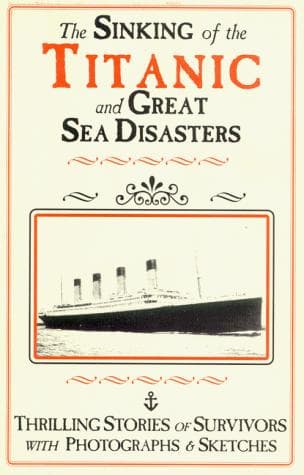
Shipwrecks -- North Atlantic Ocean; Titanic (Steamship)
Up to this time there had been no panic; but about one hour before
the ship plunged to the bottom there were three separate explosions of
bulkheads as the vessel filled. These were at intervals of about fifteen
minutes. From that time there was a different scene. The rush for the
remaining boats became a stampede.
The stokers rushed up from below and tried to beat a path through the
steerage men and women and through the sailors and officers, to get into
the boats. They had their iron bars and shovels, and they struck down
all who stood in their way.
The first to come up from the depths of the ship was an engineer. From
what he is reported to have said it is probable that the steam fittings
were broken and many were scalded to death when the Titanic lifted. He
said he had to dash through a narrow place beside a broken pipe and his
back was frightfully scalded.
Right at his heels came the stokers. The officers had pistols, but they
could not use them at first for fear of killing the women and children.
The sailors fought with their fists and many of them took the stoke bars
and shovels from the stokers and used them to beat back the others.
Many of the coal-passers and stokers who had been driven back from
the boats went to the rail, and whenever a boat was filled and lowered
several of them jumped overboard and swam toward it trying to climb
aboard. Several of the survivors said that men who swam to the sides of
their boats were pulled in or climbed in.
Dozens of the cabin passengers were witnesses of some of the frightful
scenes on the steerage deck. The steerage survivors said that ten women
from the upper decks were the only cool passengers in the life-boat, and
they tried to quiet the steerage women, who were nearly all crazed with
fear and grief.
OTHER HEROES
Among the chivalrous young heroes of the Titanic disaster were
Washington A. Roebling, 2d, and Howard Case, London representative of
the Vacuum Oil Company. Both were urged repeatedly to take places in
life-boats, but scorned the opportunity, while working against time to
save the women aboard the ill-fated ship. They went to their death, it
is said by survivors, with smiles on their faces.
Both of these young men aided in the saving of Mrs. William T. Graham,
wife of the president of the American Can Company, and Mrs. Graham's
nineteen-year-old daughter, Margaret.
Afterwards relating some of her experiences Mrs. Graham said:
"There was a rap at the door. It was a passenger whom we had met shortly
after the ship left Liverpool, and his name was Roebling--Washington A.
Roebling, 2d. He was a gentleman and a brave man. He warned us of
the danger and told us that it would be best to be prepared for an
emergency. We heeded his warning, and I looked out of my window and saw
a great big iceberg facing us. Immediately I knew what had happened and
we lost no time after that to get out into the saloon.
"In one of the gangways I met an officer of the ship.
Public-domain text, read in full here on John Shaqi.
Reviews
Reviews
No reviews yet
Be the first to share your thoughts on this work.
Join the Discussion
Join the discussion
Sign in to leave a comment or review.
Sign InorCreate an account