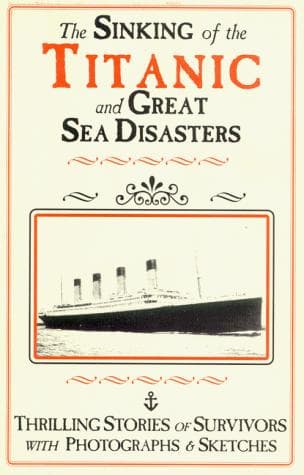
Shipwrecks -- North Atlantic Ocean; Titanic (Steamship)
To many of those who went it was harder to go than to stay there on the
vessel gaping with its mortal wounds and ready to go down. It meant that
tossing on the waters they must wait in suspense, hour after hour even
after the lights of the ship were engulfed in appalling darkness, hoping
against hope for the miracle of a rescue dearer to them than their own
lives.
It was the tradition of Anglo-Saxon heroism that was fulfilled in the
frozen seas during the black hours of Sunday night. The heroism was that
of the women who went, as well as of the men who remained!
CHAPTER VII. LEFT TO THEIR FATE
COOLNESS AND HEROISM OF THOSE LEFT TO PERISH--SUICIDE OF
MURDOCK--CAPTAIN SMITH'S END--THE SHIP'S BAND PLAYS A NOBLE HYMN AS THE
VESSEL GOES DOWN
THE general feeling aboard the ship after the boats had left her
sides was that she would not survive her wound, but the passengers who
remained aboard displayed the utmost heroism.
William T. Stead, the famous English journalist, was so litt{l}e alarmed
that he calmly discussed with one of the passengers the probable height
of the iceberg after the Titanic had shot into it.
Confidence in the ability of the Titanic to remain afloat doubtlessly
led many of the passengers to death. The theory that the great ship was
unsinkable remained with hundreds who had entrusted themselves to the
gigantic hulk, long after the officers knew that the vessel could not
survive.
The captain and officers behaved with superb gallantry, and there was
perfect order and discipline among those who were aboard, even after all
hope had been abandoned for the salvation of the ship.
Many women went down, steerage women who were unable to get to the upper
decks where the boats were launched, maids who were overlooked in the
confusion, cabin passengers who refused to desert their husbands or who
reached the decks after the last of the life-boats was gone and the ship
was settling for her final plunge to the bottom of the Atlantic.
Narratives of survivors do not bear out the supposition that the final
hours upon the vessel's decks were passed in darkness. They say the
electric lighting plant held out until the last, and that even as they
watched the ship sink, from their places in the floating life-boats, her
lights were gleaming in long rows as she plunged under by the head. Just
before she sank, some of the refugees say, the ship broke in two abaft
the engine room after the bulkhead explosions had occurred.
COLONEL ASTOR'S DEATH
To Colonel Astor's death Philip Mock bears this testimony.
"Many men were hanging on to rafts in the sea. William T. Stead and
Colonel Astor were among them. Their feet and hands froze and they had
to let go. Both were drowned."
The last man among the survivors to speak to Colonel Astor was K.
Whiteman, the ship's barber.
Public-domain text, read in full here on John Shaqi.
Reviews
Reviews
No reviews yet
Be the first to share your thoughts on this work.
Join the Discussion
Join the discussion
Sign in to leave a comment or review.
Sign InorCreate an account