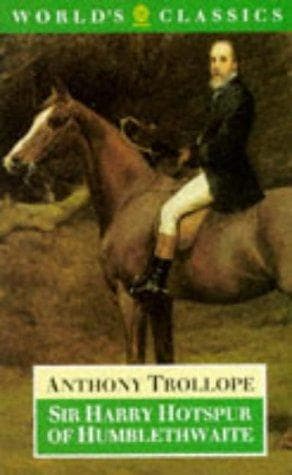
Sir Harry Hotspur of HumblethwaiteTrollope, Anthony
General
Sir Harry Hotspur of Humblethwaite
Trollope, Anthony
Cumberland (England) -- Fiction; Domestic fiction; Fathers and daughters -- Fiction; Inheritance and succession -- Fiction
The reader need hardly be told that Emily herself regarded the matter
in a very different light. She also had her ideas about the delicacy
and the aroma of a maiden's love. She had confessed her love very
boldly to the man who had asked for it; had made her rich present
with a free hand, and had grudged nothing in the making of it. But
having given it, she understood it to be fixed as the heavens that
she could never give the same gift again. It was herself that she
had given, and there was no retracting the offering. She had thought,
and had then hoped, and had afterwards hoped more faintly, that the
present had been well bestowed;--that in giving it she had disposed
of herself well. Now they told her that it was not so, and that she
could hardly have disposed of herself worse. She would not believe
that; but, let it be as it might, the thing was done. She was his.
He had a right in her which she could not withdraw from him. Was not
this sort of giving acknowledged by all churches in which the words
for "better or for worse" were uttered as part of the marriage vow?
Here there had been as yet no church vow, and therefore her duty
was still due to her father. But the sort of sacrifice,--so often a
sacrifice of the good to the bad,--which the Church not only allowed
but required and sanctified, could be as well conveyed by one promise
as by another. What is a vow but a promise? and by what process are
such vows and promises made fitting between a man and a woman? Is it
not by that compelled rendering up of the heart which men call love?
She had found that he was dearer to her than everything in the world
besides; that to be near him was a luxury to her; that his voice was
music to her; that the flame of his eyes was sunlight; that his touch
was to her, as had never been the touch of any other human being.
She could submit to him, she who never would submit to any one. She
could delight to do his bidding, even though it were to bring him his
slippers. She had confessed nothing of this, even to herself, till he
had spoken to her on the bridge; but then, in a moment, she had known
that it was so, and had not coyed the truth with him by a single nay.
And now they told her that he was bad.
Bad as he was, he had been good enough to win her. 'Twas thus she
argued with herself. Who was she that she should claim for herself
the right of having a man that was not bad? That other man that had
come to her, that Lord Alfred, was, she was told, good at all points;
and he had not moved her in the least. His voice had possessed no
music for her; and as for fetching his slippers for him,--he was to
her one of those men who seem to be created just that they might
be civil when wanted and then get out of the way! She had not been
able for a moment to bring herself to think of regarding him as her
husband. But this man, this bad man! From the moment that he had
spoken to her on the bridge, she knew that she was his for ever.
Public-domain text, read in full here on John Shaqi.
Reviews
Reviews
No reviews yet
Be the first to share your thoughts on this work.
Elsewhere in the archive
Join the Discussion
Join the discussion
Sign in to leave a comment or review.
Sign InorCreate an account