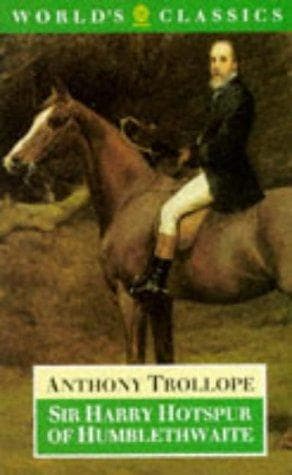
Sir Harry Hotspur of HumblethwaiteTrollope, Anthony
General
Sir Harry Hotspur of Humblethwaite
Trollope, Anthony
Cumberland (England) -- Fiction; Domestic fiction; Fathers and daughters -- Fiction; Inheritance and succession -- Fiction
It might be that she liked a bad man best. So she argued with herself
again. If it were so she must put up with what misfortune her own
taste might bring upon her. At any rate the thing was done, and why
should any man be thrown over simply because the world called him
bad? Was there to be no forgiveness for wrongs done between man and
man, when the whole theory of our religion was made to depend on
forgiveness from God to man? It is the duty of some one to reclaim an
evident prodigal; and why should it not be her duty to reclaim this
prodigal? Clearly, the very fact that she loved the prodigal would
give her a potentiality that way which she would have with no other
prodigal. It was at any rate her duty to try. It would at least be
her duty if they would allow her to be near enough to him to make
the attempt. Then she filled her mind with ideas of a long period
of probation, in which every best energy of her existence should
be given to this work of reclaiming the prodigal, so that at last
she might put her own hand into one that should be clean enough
to receive it. With such a task before her she could wait. She
could watch him and give all her heart to his welfare, and never be
impatient except that he might be made happy. As she thought of this,
she told herself plainly that the work would not be easy, that there
would be disappointment, almost heart-break, delays and sorrows; but
she loved him, and it would be her duty; and then, if she could be
successful, how great, how full of joy would be the triumph! Even
if she were to fail and perish in failing, it would be her duty. As
for giving him up because he had the misfortune to be bad, she would
as soon give him up on the score of any other misfortune;--because
he might lose a leg, or become deformed, or be stricken deaf by
God's hand! One does not desert those one loves, because of their
misfortunes! 'Twas thus she argued with herself, thinking that she
could see,--whereas, poor child, she was so very blind!
"Mamma," she said, "has Papa gone up to town about Cousin George?"
"I do not know, my dear. He did not say why he was going."
"I think he has. I wish I could make him understand."
"Understand what, my dear?"
"All that I feel about it. I am sure it would save him much trouble.
Nothing can ever separate me from my cousin."
"Pray don't say so, Emily."
"Nothing can. Is it not better that you and he should know the truth?
Papa goes about trying to find out all the naughty things that George
has ever done. There has been some mistake about a race meeting, and
all manner of people are asked to give what Papa calls evidence that
Cousin George was there. I do not doubt but George has been what
people call dissipated."
"We do hear such dreadful stories!"
"You would not have thought anything about them if it had not been
for me. He is not worse now than when he came down here last year.
And he was always asked to Bruton Street."
"What do you mean by this, dear?"
Public-domain text, read in full here on John Shaqi.
Reviews
Reviews
No reviews yet
Be the first to share your thoughts on this work.
Elsewhere in the archive
Join the Discussion
Join the discussion
Sign in to leave a comment or review.
Sign InorCreate an account