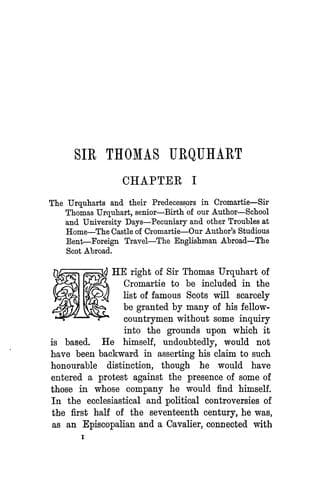
The determined efforts of Charles I. and his advisers to make the Church
of Scotland in all respects like the Church of England, were fiercely
opposed, and, for a time, the party which was resolved to make them as
dissimilar as possible prevailed. Episcopacy, liturgy, ancient
ecclesiastical customs and rites, and all that savoured of Prelacy or
Popery, were swept away by the rising flood. Yet, without committing
oneself to the doctrine of passive obedience, it may be doubted whether
the course of policy followed by the Covenanters was either wise or
scriptural. For, notwithstanding the vehement protestations of loyalty
expressed in the National Covenant, armed resistance to the royal
authority was not obscurely hinted at in it. "We," said the subscribers,
"promise and swear by the great name of the Lord our God to continue in
the profession and obedience of the said religion; and that we shall
defend the same, and resist all those contrary errors and corruptions,
according to our vocation, and to the utmost of that power which God
hath put into our hands, all the days of our life." It is quite
possible, it may be hoped, for one to be in sympathy with a certain
political party, and yet to regret that the Church should identify
itself with that party; and it certainly was not in the end a good thing
for the cause of religion that it should have been so closely allied as
it was with party politics in the seventeenth century. "My kingdom is
not of this world," said Christ; "if My kingdom were of this world, then
would My servants fight." "Put up again thy sword into his place," He
said to St Peter, "for all they that take the sword, shall perish with
the sword." It is difficult to see how these clear and emphatic
utterances can be made to harmonise with the resolution not only to use
force in the correction of ecclesiastical abuses and religious errors,
but also to coerce those who were not prepared to follow the same course
of policy.[44]
The Covenanting party were successful beyond their hopes. The influence
of the Marquis of Argyle secured the allegiance to the cause of the
Highlanders in the west of Scotland; while, in Inverness and the region
north of the Moray Firth, the movement was enthusiastically welcomed.
Only one district in Scotland held aloof--that of which Aberdeen was the
centre. The community there had probably but little sympathy with the
innovations which Laud was bent upon bringing in, but they had still
less with the Covenant. They were attached to the modified form of
Episcopacy which had now existed in Scotland since the Reformation
(with the exception of the years between 1592 and 1610), in which the
bishops were little more than permanent moderators of Presbyteries, and
were subject to the General Assembly, and in which the ritual was of a
very simple character.
Public-domain text, read in full here on John Shaqi.
Reviews
Reviews
No reviews yet
Be the first to share your thoughts on this work.
Join the Discussion
Join the discussion
Sign in to leave a comment or review.
Sign InorCreate an account