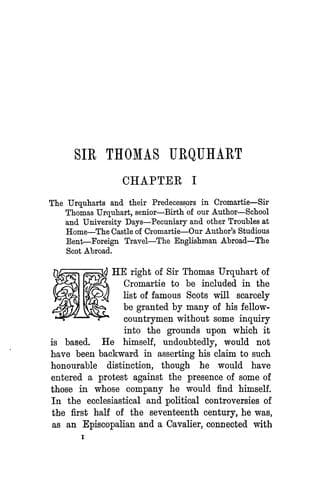
The right of Sir Thomas Urquhart of Cromartie to be included in the
list of famous Scots will scarcely be granted by many of his
fellow-countrymen without some inquiry into the grounds upon which it is
based. He himself, undoubtedly, would not have been backward in
asserting his claim to such honourable distinction, though he would have
entered a protest against the presence of some of those in whose company
he would find himself. In the ecclesiastical and political controversies
of the first half of the seventeenth century, he was, as an Episcopalian
and a Cavalier, connected with the losing side, and, consequently, it
is not to be expected that posterity should be so impartial as to
cherish his name along with those of the victors in the conflict. It is
to his literary, and not to his martial achievements, that he owes his
fame. His translation of Rabelais is probably the most brilliant feat of
the kind ever accomplished, and casts all his own original writings into
the shade. The fantastical character of his own compositions, indeed,
both in regard to their subject-matter and the diction in which they are
clothed, forbids their ever having a large circle of readers. An author
whose phraseology is like a combination of that used by Ancient Pistol
with that of Sir Thomas Browne may have enthusiastic admirers, but they
are almost certain to be few in number. Yet his works contain much
interesting matter, and to them we are indebted for many details of the
life of their author.
Though it is hard to believe Sir Thomas Urquhart's assertion that the
connexion of the Urquharts with the north-west of Scotland dates as far
back as the year B.C. 554, when an ancestor of his named Beltistos
crossed over from Ireland, and built a castle near Inverness, the family
was of considerable antiquity, and for many generations was one of the
most distinguished in that part of the country. Nisbet, the great
authority on heraldry, says that "they enjoyed not only the honourable
office of hereditary Sheriff-Principal of the Shire of Cromartie, but
the far greater part, if not the whole of the said shire did belong to
them, either in property or superiority, and they possessed a
considerable estate besides in the Shire of Aberdeen."[1] The admiralty
of the seas from Caithness to Inverness also belonged to them.
The Urquharts were not, however, the earliest to bear rule in the part
of Scotland with which their name is connected. Cromartie was originally
the Crwmbawchty (or Crumbathy) of which Macbeth was reputed thane,
before he became king. Wyntown in his _Cronykil_ relates Macbeth's dream
that he was first Thane of Cromartie, then Thane of Moray, and then King
of Scotland.[2] After the first and second titles had been conferred
upon him, he took steps to secure the third. Probably the mote-hill of
Cromartie was the site of his official residence as thane of the
district when he was at the beginning of his ambitious career.
Public-domain text, read in full here on John Shaqi.
Reviews
Reviews
No reviews yet
Be the first to share your thoughts on this work.
Join the Discussion
Join the discussion
Sign in to leave a comment or review.
Sign InorCreate an account