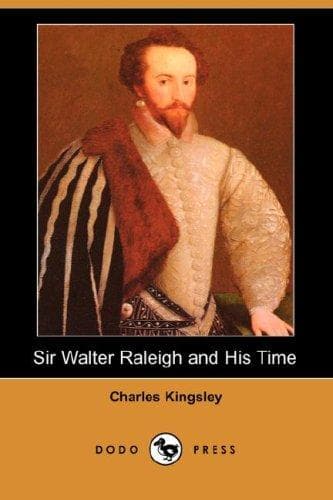
Great Britain -- History; Raleigh, Walter, Sir, 1552?-1618
This famous passage is one of those over which the virtuosity of modern
times, rejoicing in evil, has hung so fondly, as giving melancholy proof
of the ‘duplicity of Raleigh’s character’; as if a man who once in his
life had told an untruth was proved by that fact to be a rogue from birth
to death: while others have kindly given him the benefit of a doubt
whether the letter were not written after a private marriage, and
therefore Raleigh, being ‘joined unto’ some one already, had a right to
say that he did not wish to be joined to any one. But I do not concur in
this doubt. Four months after, Sir Edward Stafford writes to Anthony
Bacon, ‘If you have anything to do with Sir W. R., or any love to make to
Mistress Throgmorton, at the Tower to-morrow you may speak with them.’
This implies that no marriage had yet taken place. And surely, if there
had been private marriage, two people who were about to be sent to the
Tower for their folly would have made the marriage public at once, as the
only possible self-justification. But it is a pity, in my opinion, that
biographers, before pronouncing upon that supposed lie of Raleigh’s, had
not taken the trouble to find out what the words mean. In their virtuous
haste to prove him a liar, they have overlooked the fact that the words,
as they stand, are unintelligible, and the argument self-contradictory.
He wants to prove, we suppose, that he does not go to sea for fear of
being forced to marry Miss Throgmorton. It is, at least, an unexpected
method of so doing in a shrewd man like Raleigh, to say that he wishes to
marry no one at all. ‘Don’t think that I run away for fear of a
marriage, for I do not wish to marry any one on the face of the earth,’
is a speech which may prove Raleigh to have been a fool, and we must
understand it before we can say that it proves him a rogue. If we had
received such a letter from a friend, we should have said at once, ‘Why
the man, in his hurry and confusion, has omitted _the_ word; he must have
meant to write, not “There is none on the face of the earth that I would
be fastened to,” but “There is none on the face of the earth that I would
_rather_ be fastened to,”‘ which would at once make sense and suit fact.
For Raleigh not only married Miss Throgmorton forthwith, but made her the
best of husbands. My conjectural emendation may go for what it is worth:
but that the passage, as it stands in Murdin’s State Papers (the MSS. I
have not seen) is either misquoted, or mis-written by Raleigh himself, I
cannot doubt. He was not one to think nonsense, even if he scribbled it.
Public-domain text, read in full here on John Shaqi.
Reviews
Reviews
No reviews yet
Be the first to share your thoughts on this work.
Join the Discussion
Join the discussion
Sign in to leave a comment or review.
Sign InorCreate an account