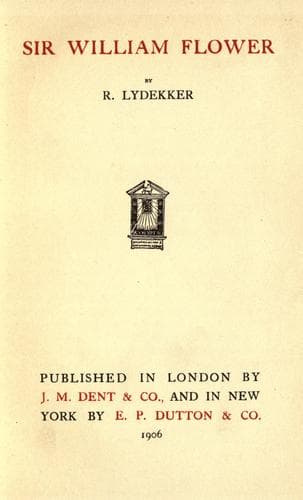
Flower, William Henry, 1831-1899; Zoologists -- Great Britain -- Biography
Of the Royal Society Sir William was elected a Fellow in 1864—at the
relatively early age of thirty-three—and he served on the Council of that
body for three separate periods, namely from 1868 to 1870, from 1876 to
1878, and again from 1884 to 1886, while in 1884 and 1885 he was one
of the Vice-Presidents. In 1882 his conspicuous services to zoological
science was recognised by the bestowal upon him of a Royal Gold Medal—one
of the most honourable distinctions in the gift of the Society; the other
recipient in the same year of a similar honour being Lord Rayleigh. In
handing to Professor Flower this medal, the President dwelt upon the
value of his contributions to both zoology and anthropology, referring,
in connection with the former science, to his paper on the classification
of the Carnivora, and, in respect to the latter, to the then recently
published first part of the “Catalogue of Osteological Specimens in the
Museum of the Royal College of Surgeons,” in which descriptions and
measurements of between 1300 and 1400 human skulls are recorded. The
present writer has been informed that Flower refused to be nominated
for the Presidentship of the Royal Society, owing to the fear that the
calls made upon his time by that office would interfere with his official
duties. Of the Zoological Society Professor Flower became a Fellow so
long ago as the year 1851, that is to say, three years previous to the
commencement of his Crimean service. After serving for several periods
on the Council he was elected to the honourable (and honorary) office
of President on the death of the Marquis of Tweeddale in 1879, and
in this important position he remained till his death. It should be
added that Flower never received one of the medals of the Zoological
Society, and this for the very good reason that such rewards are
bestowed in recognition of gifts to the Society’s Menagerie, and not for
contributions to zoological knowledge. Flower’s contributions to both
the _Transactions_ and the _Proceedings_ of the Society were numerous,
and, needless to say, valuable; the earliest in the former having been
published in 1866, and in the latter in 1852. With very few exceptions,
these communications relate to mammals. Fuller details with regard to Sir
William’s Presidency of the Zoological Society will be found in a later
chapter.
Of the Linnean Society, Flower was elected a Fellow in 1862, but he does
not appear to have ever taken any active part in the administration of
that body, or to have contributed to its publications, although for a
time he was a Vice-President.
Public-domain text, read in full here on John Shaqi.
Reviews
Reviews
No reviews yet
Be the first to share your thoughts on this work.
Join the Discussion
Join the discussion
Sign in to leave a comment or review.
Sign InorCreate an account