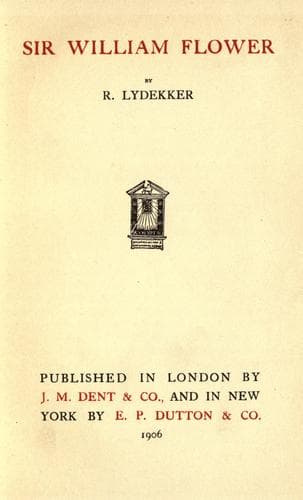
Flower, William Henry, 1831-1899; Zoologists -- Great Britain -- Biography
“As there is no matter of such great importance in a catalogue as the
correct naming of the objects described in it, this part of the subject
has engaged a very large share of attention in preparing the work. I
am not sanguine enough to suppose that the names I have adopted—always
after careful research and consideration—will in every case be deemed
satisfactory by other zoologists, yet I hope that some advance will
have been made towards that most desirable end—a fixed and generally
recognised nomenclature of all the best-known species of mammals.
Having selected the generic and specific name which I considered most
appropriate, I have given the place and date of their first occurrence,
but have only admitted such synonyms as have found their way into
standard works, judging it better that the remainder should be buried in
oblivion, or at all events only retained in professedly bibliographical
treatises. In selecting the name chosen, I have been mainly guided by
the views which have been gradually gaining general currency among
conscientious naturalists of all nations, and which were formulated in
what is commonly called the Stricklandian Code, adopted by a Committee
of the British Association for the Advancement of Science in 1842, and
revised and reprinted by the Association in 1865, and again in 1878....
The regulations laid down in these codes for the formation of new names
are unimpeachable; and although some of the rules for the selection
of names already in existence have given rise to criticism, and are
occasionally difficult of practical application when an endeavour is made
to enforce them too rapidly, they do in the main, when interpreted with
discretion and common-sense, lead to satisfactory results. As what we are
aiming at is simply convenience and general accord, and not abstract
justice or truth, there are cases in which the rigid law of priority,
even if it can be ascertained, requires qualification, as it is certainly
not advisable to revive an obsolete or almost unknown name at the
expense of one, which if not strictly legitimate, has been universally
accepted and become thoroughly incorporated in zoological and anatomical
literature; and it is often better to put up with a small error or
inconvenience in an existing name than to incur the much larger confusion
caused by the introduction of a new one.”
Public-domain text, read in full here on John Shaqi.
Reviews
Reviews
No reviews yet
Be the first to share your thoughts on this work.
Join the Discussion
Join the discussion
Sign in to leave a comment or review.
Sign InorCreate an account