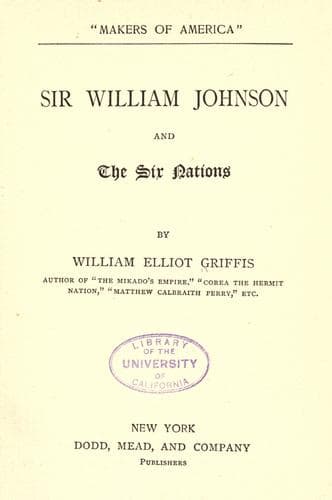
Sir William Johnson and the Six NationsGriffis, William Elliot
History
Sir William Johnson and the Six Nations
Griffis, William Elliot
Johnson, William, 1715-1774; United States -- History -- French and Indian War, 1754-1763
Johnson first heard of this event in a letter from Colonel Gage,—him
who married an American wife, and afterward occupied Boston with the
redcoats, only to be compelled to leave it at the request of Washington,
his old comrade-in-arms on Braddock’s Field. It is a curious coincidence
that Colonel Gage has unwittingly furnished Yankee Boston with a public
holiday in honour of Ireland’s patron, Saint Patrick,—which the Irish
majority in the Boston City Council first inaugurated in 1890, under the
disguise of “Evacuation Day.” The date which the Frenchmen chose for
their approach to Fort William Henry was the date also on which Gage, in
1775, sailed away to the land whence the Canadians had come in 1757.
Johnson’s tremendous energies now shone forth. He at once summoned the
Mohawk Valley militia, and sent his trusty interpreter, Arent Stevens,
to rouse the Mohawks. The meeting-place was at his house. The news came
on Sunday the 24th; and on Monday, at daylight, the column of twelve
hundred militia and the Indians were on the march which in less than
four days brought them to Fort William Henry.
Finding the enemy gone, Johnson allowed his men two days’ rest, and was
about to start homeward, when hearing that the French meditated a blow
on the frontier village of German Flats, he kept in the saddle all
night, reaching home at four A. M. Fortunately the news was not
confirmed; but he nevertheless ordered the militia to Burnet’s Field,
and made his headquarters there. This energetic action had a good effect
upon the Iroquois who had been invited to the grand council at Fort
Johnson, as his house was now called, and on the 10th of June the
proceedings were duly opened. The result of the ten days’ conference was
that the neutrality of the Senecas, Cayugas, and Onondagas was secured;
while the three other tribes—the Oneidas, Tuscaroras, and Mohawks—were
heartily enlisted to fight for the English against the French.
Summer passed away in Johnson’s despatching Indian parties to Canada; in
Governor Hardy’s returning to the more congenial quarter-deck,
exchanging civil for naval life; in Loudon’s making a grand failure at
Louisburg, as usual blaming the colonial officers and troops for his own
blunders; and in the shameful loss of Fort William Henry through the
cowardice of General Webb.
Public-domain text, read in full here on John Shaqi.
Reviews
Reviews
No reviews yet
Be the first to share your thoughts on this work.
Elsewhere in the archive
Join the Discussion
Join the discussion
Sign in to leave a comment or review.
Sign InorCreate an account