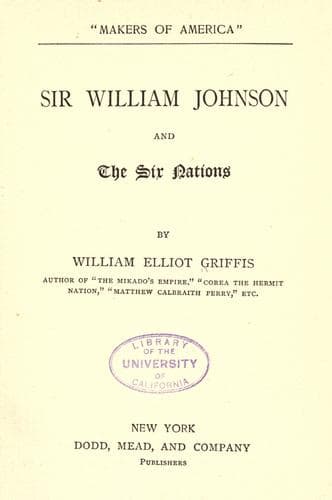
Sir William Johnson and the Six NationsGriffis, William Elliot
History
Sir William Johnson and the Six Nations
Griffis, William Elliot
Johnson, William, 1715-1774; United States -- History -- French and Indian War, 1754-1763
So passed another year of failure. John Campbell, Scotsman, otherwise
called Earl of Loudon, had been sent out as the representative of Lord
Halifax and of the Lords of Trade. Having decided to unite all the
colonies under military rule, and force them to support a standing army,
they selected this man, who was strong in the idea of colonial
subordination, but was vacillating, incapable, vain, wasteful, and lazy.
His first winter campaign consisted chiefly in scolding Shirley, and
making the Massachusetts governor the scapegoat for his own
shortcomings; in disgusting the people of New York by billeting his
officers upon them; and in both New York and Boston diligently hastening
the separation of the colonies from Great Britain by making a fool of
himself generally.
With the regulars in winter quarters, the militia dismissed to their
homes, the whole frontier, except in the Lake George region, open and
exposed, five of the Six Nations practically alienated from the English
and already making terms with the French, the outlook was dark.
However, the Mohawks were faithful; and Johnson took heart, believing he
could yet win and hold the Iroquois. Sending his captains, the two
Butlers, and Jellis Fonda to the various castles, and to the fireplace
of the Confederacy at Onondaga, he appointed a great council to meet,
June 10, 1757. Meanwhile he sent the Mohawks out upon the war-path, and
had the satisfaction of hearing of the repulse of the French and the
safe defence of the Fort William Henry which he had built two years
before at Lake George. Major William Eyre, the ordnance officer who had
served the guns so efficiently at the battle of Lake George against
Dieskau’s regulars, was in command of the fort, with four hundred men.
The commander of the American rangers, with Eyre, was John Stark. The
long and dreary winter was nearly over, and Saint Patrick’s Day was at
hand. The French knew as well that the Irish soldiers would be drunk on
the 18th of March, as Washington knew that the Hessians would be unfit
for clear-headed fighting the day after Christmas. Fortunately, through
the thoughtfulness of the future hero of Bennington, his own rangers
were kept sober by enforced total abstinence, and the Irish had the rum
and drunkenness all to themselves. The French force of fifteen hundred
regulars, wood-rangers, and savages came down the lakes on the ice,
dragging, each man, his sledge containing provisions, arms, and various
equipments, among which were three hundred scaling-ladders. They began a
furious attack at sunrise on the 18th, expecting easy victory; but Eyre
used his artillery with such deadly effect that despite four separate
attacks within twenty-four hours, the expedition ended in total failure.
Seized with a panic, the besiegers fled, leaving their sledges and much
valuable property behind, besides their dead.
Public-domain text, read in full here on John Shaqi.
Reviews
Reviews
No reviews yet
Be the first to share your thoughts on this work.
Elsewhere in the archive
Join the Discussion
Join the discussion
Sign in to leave a comment or review.
Sign InorCreate an account