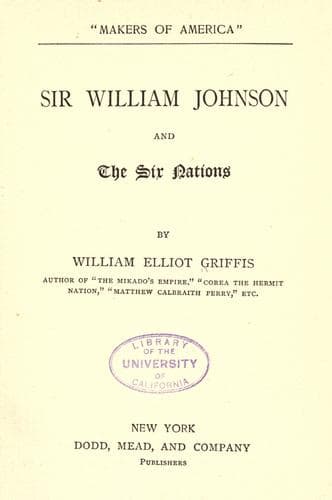
Sir William Johnson and the Six NationsGriffis, William Elliot
History
Sir William Johnson and the Six Nations
Griffis, William Elliot
Johnson, William, 1715-1774; United States -- History -- French and Indian War, 1754-1763
Johnson was so heartily disgusted with the state of affairs that it is
probable that his sickness in October and November was a direct result
of exposure in camp, and distraction of mind. He knew that the French
would now at the first opportunity strike the western frontier. He
therefore wrote to Abercrombie in September, to reinforce the Valley
forts and send scouts and rangers to German Flats. All such warnings,
however, were like “an east wind in an ass’s ears.” Abercrombie and his
men drilled, drank, swore, gambled, dug ditches, and caricatured the
Dutch people in church, and otherwise amused themselves in Albany. At
German Flats the long strain of duty in watch and ward resulted in the
inevitable reaction; and when the danger was greatest and nearest, the
nerves relaxed, the midnight lantern went out, and the sentinel and
people alike slept. The friendly Oneidas informed the Germans, fifteen
days in advance, of the enemy’s movements. A week later, a chief came in
person to warn them; but the people took it as a joke, laughed in his
face, and sent no word to Johnson. Tired of hearing the cry of “wolf,”
they neglected to provide for their sheep. Despite the fort, the
block-houses, and the militia company of one hundred men, the blow fell.
Fortunately the minister and some of his people heeded the friendly
warning of the Oneidas, and the day before the attack, crossed the river
to a place of safety. Those left were infatuated until the last moment.
It was on the morning of Nov. 13, 1757, that the Canadian, Belletre, and
his three hundred white and red savages surrounded the doomed village,
raised the yell, and began the attack. The people were dazed. After some
fitful musketry-firing, the Indians succeeded in setting the houses on
fire, and in tomahawking and scalping the people as they rushed out of
the flames. One of the block-houses was surrendered by the head man of
the village, who asked for quarter. Numbers of the people were killed as
they ran out to the fording-place of the river to escape to the opposite
side, or were shot while in the water. The settlement was totally
destroyed. Of the three hundred people, a sixth were killed and one half
taken prisoners; the remainder escaped, or had already fled to Fort
Herkimer. The abundant live-stock was destroyed or driven off, and the
place left in ashes. All this was done almost under the eyes of the
commander of Fort Herkimer, but a short distance off, across the Mohawk
River. Having a small garrison, he, though fully warned by Oneida
Indians of the coming blow, was unable to send assistance, and perhaps
anticipated an attack on his own post.
The people of Stone Arabia and Cherry Valley were excited, and prepared
to leave these places when the escaped refugees brought the news. Lord
Howe, with his reinforcements, though too late for action, prevented the
depopulation of the settlements.
Public-domain text, read in full here on John Shaqi.
Reviews
Reviews
No reviews yet
Be the first to share your thoughts on this work.
Elsewhere in the archive
Join the Discussion
Join the discussion
Sign in to leave a comment or review.
Sign InorCreate an account