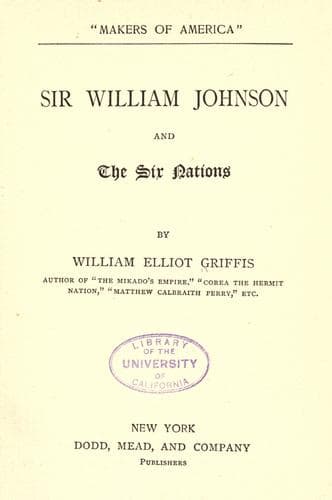
Sir William Johnson and the Six NationsGriffis, William Elliot
History
Sir William Johnson and the Six Nations
Griffis, William Elliot
Johnson, William, 1715-1774; United States -- History -- French and Indian War, 1754-1763
The sage Lord Loudon heard of this latest disaster while in Albany, and
his conduct was characteristic. Eager to find a victim on whom to vent
his rage and to bear his own and his officers’ shortcomings, he blamed
the Iroquois, and even proposed to make war against them. It was,
probably, only by the active persuasion of Johnson that he was turned
from his madness.
Imagination vainly seeks to picture the results had Loudon, the grand
master of Great Britain’s resources, even begun his folly, and broken
the peace league which Van Curler had made, Schuyler extended, and
Johnson perfected. Had he practically betrayed his country by turning
the whole Indian power of the continent over to the French, the history
of this country would have been vastly different from that we know. Had
Johnson done nothing else than prevent this, he would deserve a high
place among the Makers of America.
CHAPTER X.
THE HEAVEN-BORN GENERAL.
IT IS HARD for Americans to realize that the French and Indian War was
more costly to Great Britain than was the War of the American
Revolution. As matter of fact, the British Government sent a larger
total of soldiers and sailors, and spent more blood and treasure in
defending the colonies and in wresting North America from the French,
than in endeavouring to coerce the revolted colonies. Though in the
various attempts at the reduction of Canada, no large armies like those
of Burgoyne or Cornwallis were lost by surrender, yet the number of men
slaughtered in siege and battle was greater, and the expeditions being
in the wilderness were much more costly. To throw a bomb into the
Niagara fort was like dropping a globe of silver; to fire canister, like
scattering a Danæan shower of guineas; while every effective bullet
required an outlay of pounds, as well as of shillings and pence.
Before the decision of the long controversy between Latin and Teutonic
civilization in America, at the fall of Quebec, another terrible
disaster, caused largely by British arrogance and contempt of American
experience, remains to be recorded. This time it was to be linked not
with the name of Braddock or Loudon, but with that of Abercrombie.
Under the quickening touch of the master-hand of Pitt, who knew the
topography of America, and had appointed the “young madman” Wolfe to
supersede Loudon, Louisburg, Ticonderoga, and Fort Du Quesne were chosen
as points of attack. Of the three expeditions planned, Abercrombie was
chosen to lead that which was to move to Canada by the great water-way
of Eastern New York.
Public-domain text, read in full here on John Shaqi.
Reviews
Reviews
No reviews yet
Be the first to share your thoughts on this work.
Elsewhere in the archive
Join the Discussion
Join the discussion
Sign in to leave a comment or review.
Sign InorCreate an account